Security Cons for Dummies
This presentation provides a comprehensive guide for first-time attendees of cybersecurity conferences, outlining the typical components such as talks, workshops, and community-led activities. It emphasizes the importance of networking, note-taking, and active participation in hands-on events like Capture The Flag (CTF) competitions. The speaker demonstrates a basic Caesar cipher challenge to illustrate the practical, gamified learning opportunities available at these events. The talk serves as an orientation to help newcomers navigate and maximize the value of professional security conferences.
Beyond the Badge: Why Your First Security Conference is a Technical Force Multiplier
TLDR: Security conferences are often dismissed as networking fluff, but they are actually high-density environments for skill acquisition and practical tradecraft. By focusing on hands-on activities like CTFs and workshops rather than just sitting in talks, you can rapidly accelerate your technical proficiency. This post breaks down how to navigate these events to extract maximum value for your career as a researcher or pentester.
Walking into a security conference for the first time feels like being dropped into a high-stakes environment where everyone else seems to have a secret map. You see people huddled over laptops, soldering irons, and whiteboards, and it is easy to feel like an outsider. Many newcomers make the mistake of treating these events like a lecture hall, spending their entire time sitting in talks. While some presentations offer deep dives into novel research, the real value of a conference is found in the "hallway track" and the hands-on labs.
The Practical Value of Gamified Learning
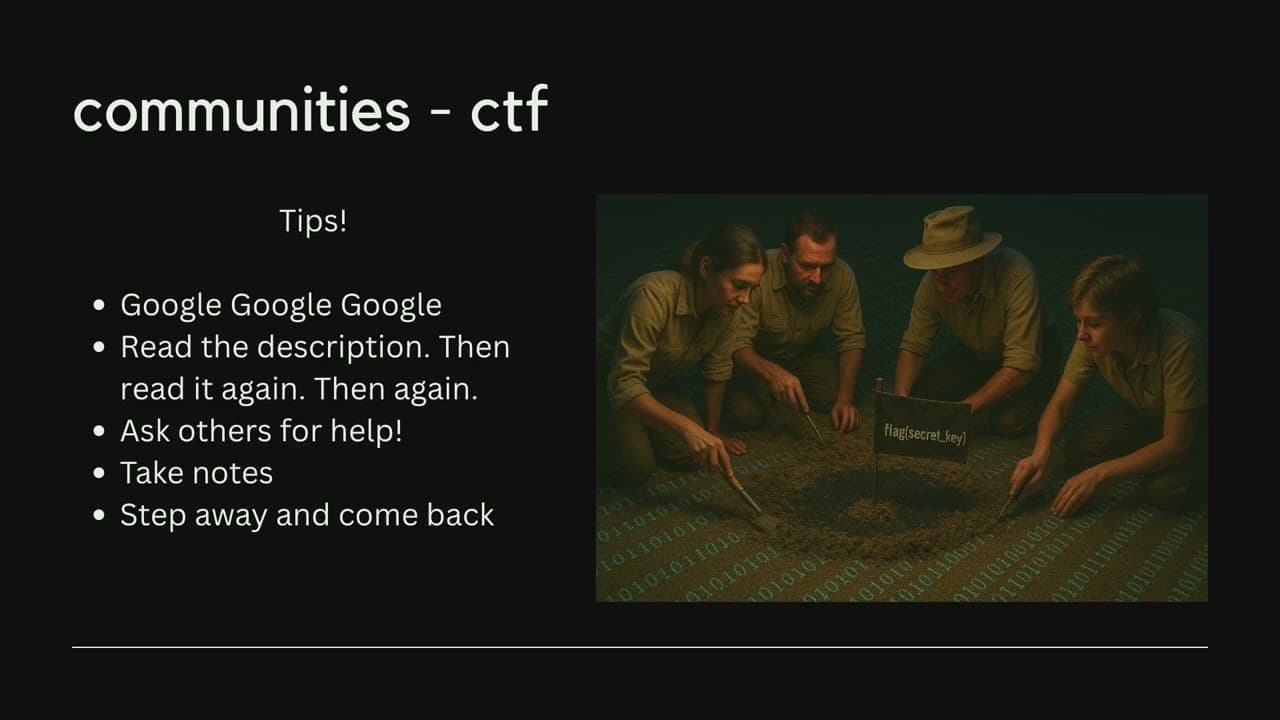
If you want to sharpen your skills, stop looking for the most popular talk and start looking for the Capture The Flag (CTF) area. CTFs are not just games; they are condensed, high-intensity training modules that force you to apply offensive techniques in a controlled environment. Whether you are dealing with a Caesar cipher or a complex web exploitation chain, the mechanics remain the same: identify the vulnerability, craft the payload, and execute.
During a recent session, I watched a participant struggle with a basic substitution cipher. It was a classic ROT13 implementation, a common trope in entry-level challenges. The participant was trying to brute-force it manually, but they were missing the underlying pattern. When you encounter these challenges, your first step should always be to analyze the input and output. If you see a string like ebzna_pelcgb_vf_shyy_bs_ubyrf, your brain should immediately recognize the character shift.
For those who have never used Kali Linux in a competitive setting, these environments are the perfect place to get comfortable with your toolchain. You will find yourself running nmap scans against local targets, using metasploit to test exploit modules, and learning how to pivot through a network. The goal is not just to get the flag; it is to understand the "why" behind the exploit. If you are stuck, ask someone. The community at these events is surprisingly open to helping people who are genuinely trying to learn.
Navigating the Hallway Track
The most important part of any conference is the people. This is what we call the "hallway track." It is where the real knowledge transfer happens. You might be struggling with a specific OWASP Top 10 vulnerability in your day job, and you will inevitably run into someone who has spent the last six months researching exactly that.
Do not be intimidated by the "experts." Most of the people you see at these events are just as curious as you are. If you see a speaker after their talk, go up and ask a specific, technical question. Avoid generic questions like "How do I get into security?" Instead, ask, "I saw you used a custom script to bypass the WAF in your demo; how did you handle the rate limiting?" That is how you build a reputation as a serious researcher.
Making the Most of Workshops
Workshops are the only time you get to sit down with an industry professional and walk through a specific attack flow step-by-step. These sessions are often limited in size, so sign up early. If you are interested in application security, look for sessions that focus on real-world scenarios, such as AppSec interview preparation or hands-on exploitation labs.
When you are in a workshop, take notes on the specific commands and flags used. If the instructor is demonstrating a technique, try to replicate it on your own machine. If you run into an error, that is a learning opportunity. Debugging your own environment is a core skill for any pentester. If you can't get the exploit to fire, you need to understand why. Is it a version mismatch? A missing dependency? A firewall rule? These are the exact problems you will face on a real engagement.
The Defensive Perspective
While our focus is offensive, you cannot be an effective researcher if you do not understand how the blue team sees your traffic. Many of the techniques you learn in a CTF will trigger alerts in a real-world environment. Understanding how to evade detection is part of the game, but understanding what you are evading is even more important. When you are testing an exploit, think about what logs you are generating. Are you leaving a trail of breadcrumbs in the web server logs? Are you triggering an EDR alert?
If you want to be a better pentester, spend some time talking to the defenders at the conference. Ask them what they look for when they are hunting for threats. Their perspective will change how you approach your own testing. You will start to see your own exploits through the eyes of the person trying to stop them.
Final Thoughts
Conferences are what you make of them. If you stay in your comfort zone, you will leave with a bag of swag and a headache. If you push yourself to participate in the CTF, engage in the hallway track, and ask the hard questions in workshops, you will leave with a new set of skills and a network of peers who can help you grow.
Don't worry about seeing everything. You won't. Focus on the topics that are relevant to your current work or the areas you want to specialize in. Take notes, stay hydrated, and most importantly, be excellent to each other. The security industry is smaller than you think, and the people you meet today might be your colleagues, mentors, or clients tomorrow. Now, go find a challenge and start breaking things.
Vulnerability Classes
Tools Used
Target Technologies
Up Next From This Conference

Similar Talks

Inside the FBI's Secret Encrypted Phone Company 'Anom'

Kill List: Hacking an Assassination Site on the Dark Web