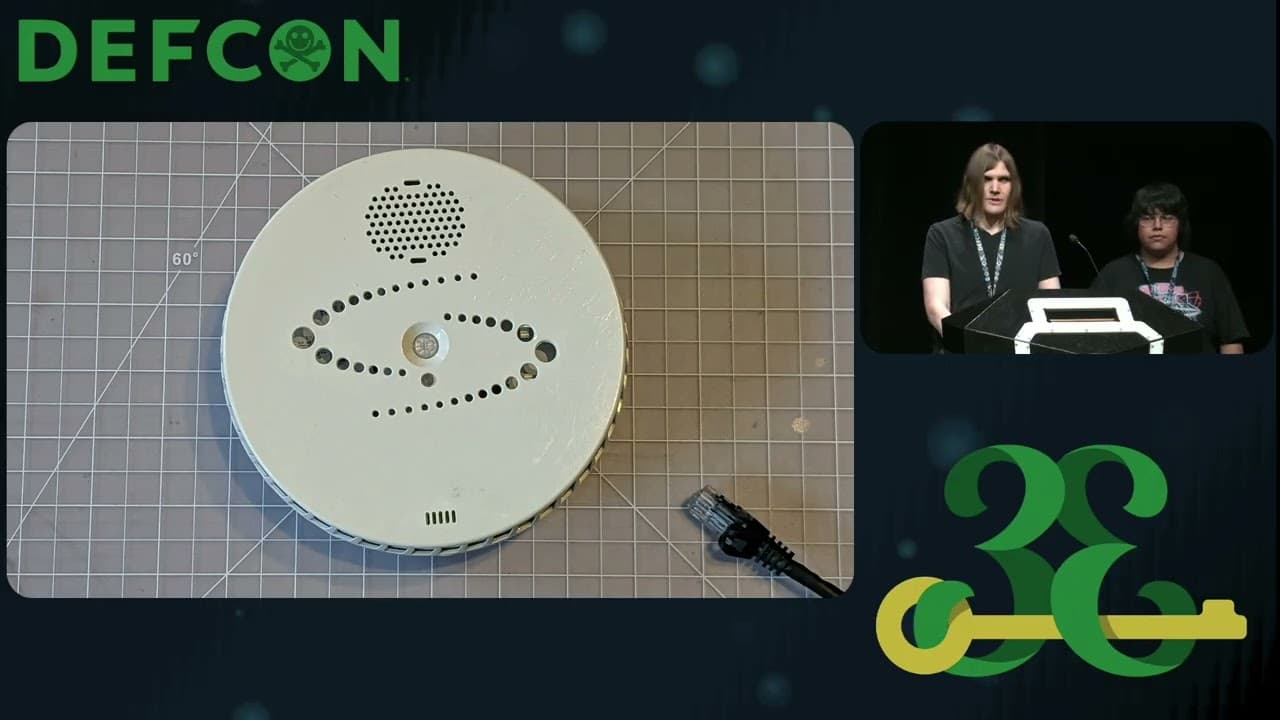
Making and Breaking NSA's Codebreaker Challenge
This talk provides an overview of the NSA's annual Codebreaker Challenge, an unclassified, mission-centric competition designed to introduce university students to real-world cybersecurity problems. The challenge features a series of increasingly difficult tasks that mirror actual technical scenarios, such as ransomware analysis, network forensics, and reverse engineering. Participants gain hands-on experience with industry-standard tools and techniques, while the competition serves as a recruitment pipeline for the agency. The presentation highlights the challenge's evolution, its impact on academic curricula, and the skills required for success.
Beyond the CTF: What the NSA’s Codebreaker Challenge Reveals About Real-World Adversary Tradecraft
TLDR: The NSA’s annual Codebreaker Challenge is more than just a recruitment tool; it is a masterclass in mapping complex, multi-stage attack chains to real-world adversary behavior. By forcing participants to pivot from log analysis to ransomware remediation and reverse engineering, the challenge highlights the critical need for integrated skill sets in modern offensive security. Pentesters and researchers should look at these scenarios as blueprints for how sophisticated actors move through a network, from initial access to data exfiltration.
Security research often suffers from a narrow focus on isolated vulnerabilities. We spend our time hunting for a specific buffer overflow or a clever bypass for a WAF, but we frequently lose sight of the broader operational context. The NSA’s Codebreaker Challenge flips this script. Instead of asking researchers to find a single bug, it presents a multi-stage, mission-centric scenario that forces participants to think like an adversary operating within a complex, compromised environment.
Mapping the Adversary Lifecycle
The brilliance of the Codebreaker Challenge lies in its structure. It does not exist in a vacuum. Each year, the challenge presents a narrative that mirrors the MITRE ATT&CK framework, moving from initial reconnaissance and access to persistence and impact.
In the 2022 iteration, for example, the mission was not just to "hack a server." It required participants to investigate a ransomware-as-a-service (RaaS) operation. This involved:
- Log Analysis: Identifying the initial point of compromise by parsing through massive datasets to find anomalous user activity.
- Network and File Forensics: Recovering attacker tools from a compromised host.
- Web Reverse Engineering: Locating and analyzing the RaaS infrastructure.
- Exploitation: Finding and leveraging vulnerabilities within the attacker's own infrastructure to recover the victim's encrypted files.
This is exactly what a high-end red team engagement looks like. You rarely get a clean path to domain admin. You get a series of breadcrumbs, a handful of suspicious logs, and a need to understand the underlying architecture of the target.
The Technical Reality of Modern Operations
Success in these challenges requires more than just running automated scanners. It demands a deep understanding of how systems interact. When the challenge requires reverse engineering a binary to extract an AES key or identifying a C2 server, it forces the participant to use tools like Ghidra.
For a pentester, the takeaway is clear: your value is not in the tool you use, but in your ability to interpret the output. If you are looking at a binary in Ghidra, you are not just looking for a vulnerability; you are looking for the logic that governs the adversary's behavior. Whether it is an Android app communicating with a C2 or a custom ransomware strain, the ability to deconstruct that logic is what separates a script kiddie from a researcher.
Why This Matters for Your Next Engagement
If you are a bug bounty hunter or a penetration tester, you should be paying attention to how these scenarios are constructed. They are designed by people who spend their careers tracking actual threats. When they build a challenge, they are essentially documenting the TTPs (Tactics, Techniques, and Procedures) they see in the wild.
Consider the 2021 scenario, which involved identifying a foreign cyber actor’s "listening post." This is a classic C2 infrastructure problem. If you are testing a client's network, are you looking for the beaconing behavior that would give away a listening post? Or are you just looking for open ports? The Codebreaker Challenge teaches you to look for the signal in the noise. It forces you to consider the network as a whole, rather than just the individual endpoints.
Defensive Parallels
Defenders can learn just as much from these challenges as attackers. If you are working with a blue team, use these scenarios to test your detection capabilities. Can your SIEM actually correlate the events that lead to a RaaS infection? If you cannot trace the path from the initial compromised user account to the final data exfiltration, you have a visibility gap. The OWASP Top 10 provides a great baseline, but the Codebreaker Challenge provides the operational context that makes those vulnerabilities dangerous.
What to Do Next
Stop treating your security research as a series of disconnected tasks. Start building your own "mission-centric" labs. Take a piece of malware, set up a C2 server, and try to trace the entire lifecycle from your own perspective. If you find yourself stuck, look at the resources provided by the NSA for their challenges. They often publish the technical requirements and the types of skills needed, which serves as a perfect syllabus for your own professional development.
The next time you are on an engagement, don't just look for the low-hanging fruit. Ask yourself what the adversary is trying to achieve, how they are moving, and what they are trying to hide. That is how you move from finding bugs to understanding the threat.
Vulnerability Classes
Tools Used
Target Technologies
Attack Techniques
Up Next From This Conference
Chained to Hit: Discovering New Vectors to Gain Remote and Root Access in SAP Enterprise Software
Zero-Touch-Pwn: Abusing Zoom's Zero Touch Provisioning for Remote Attacks on Desk Phones
ODDFuzz: Hunting Java Deserialization Gadget Chains via Structure-Aware Directed Greybox Fuzzing
Similar Talks
Inside the FBI's Secret Encrypted Phone Company 'Anom'
Hacking Apple's USB-C Port Controller