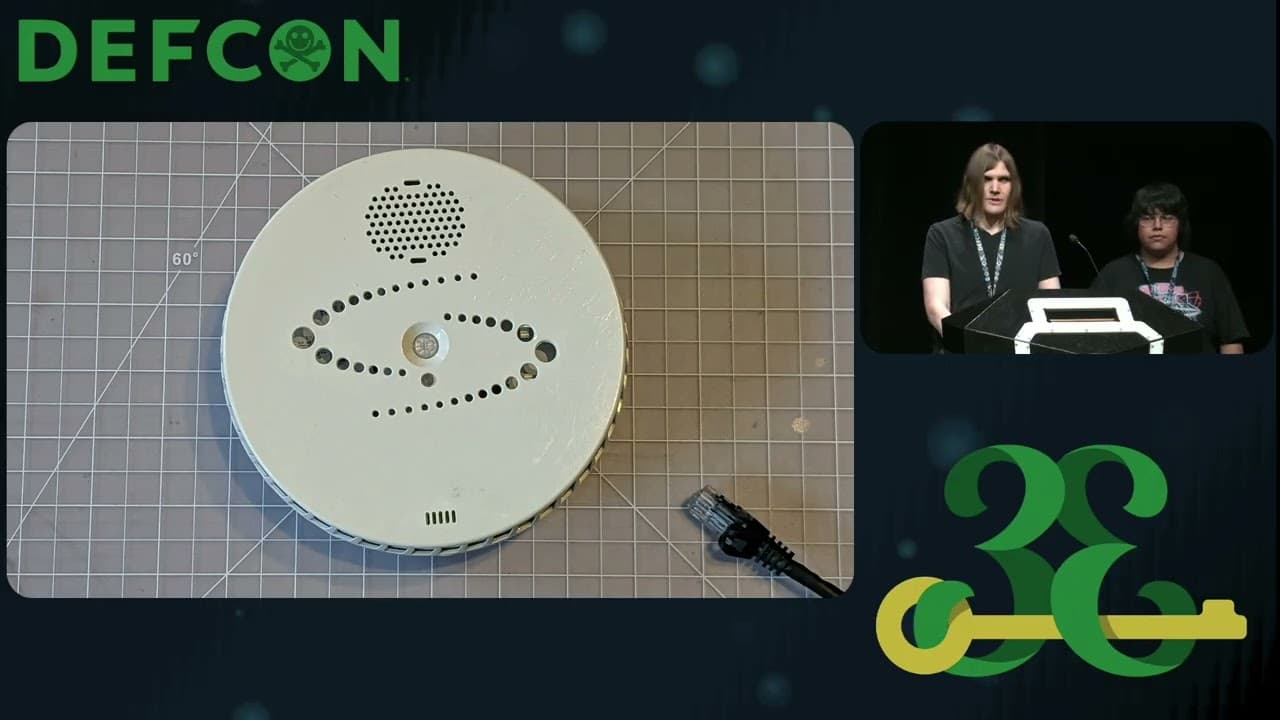
Reconfigurable HSMs: Future-Proofing Hardware Security Against Evolving Threats
This talk explores the vulnerabilities of traditional Hardware Security Modules (HSMs) and Trusted Platform Modules (TPMs) to evolving threats, specifically focusing on quantum computing risks. It demonstrates how static hardware implementations are susceptible to side-channel and timing attacks, and how they lack the flexibility to update cryptographic algorithms once deployed. The speaker proposes using reconfigurable FPGA-based devices to implement agile, updateable hardware security architectures. A custom, open-source FPGA-based HSM project called CryptoLite is presented as a proof-of-concept for this approach.
Why Your Hardware Security Module Is Already Obsolete
TLDR: Traditional Hardware Security Modules and Trusted Platform Modules rely on static, hard-coded cryptographic implementations that cannot adapt to emerging threats like quantum computing. This research demonstrates how these fixed-function devices are inherently vulnerable to side-channel and timing attacks because their physical execution paths are immutable. By shifting to reconfigurable FPGA-based architectures, security engineers can implement agile, updateable hardware that remains resilient against evolving cryptographic standards.
Hardware Security Modules (HSMs) and Trusted Platform Modules (TPMs) are the bedrock of modern trust. We treat them as black boxes that magically handle key generation, storage, and signing without leaking secrets. But the assumption that these devices are inherently secure because they are "hardware" is a dangerous fallacy. The reality is that most of these modules are built on static, fixed-function silicon. Once they leave the factory, their cryptographic logic is set in stone. If a new side-channel attack emerges or a specific algorithm like RSA becomes computationally trivial due to advancements in quantum computing, your HSM is effectively a brick.
The Problem With Static Silicon
The fundamental flaw in current HSM design is the lack of cryptographic agility. When you deploy a TPM on a motherboard, you are locking yourself into a specific set of algorithms and implementation methods. If researchers discover a timing attack that exploits the specific way your module performs modular exponentiation, you cannot patch the hardware. You are stuck with the vulnerability until you physically replace the component.
This is not just a theoretical concern. We are currently seeing a shift where OWASP Cryptographic Failures are increasingly tied to implementation flaws rather than just weak key management. When a device uses a fixed hardware path for encryption, it often exhibits consistent power consumption or timing signatures. An attacker with physical access or even proximity can monitor these side channels to reconstruct private keys. Because the hardware logic is immutable, there is no way to introduce jitter, masking, or updated algorithms to break the attacker's correlation.
Moving to Reconfigurable Security
The solution proposed in recent research is to move away from fixed-function ASICs and toward reconfigurable hardware, specifically FPGAs like the AMD Spartan-7. An FPGA allows you to define the hardware logic in code. If a vulnerability is found or a new standard is required, you simply push a new bitstream to the device.
This approach, exemplified by the CryptoLite project, changes the game for hardware security. By implementing the HSM logic on an FPGA, you gain the ability to perform remote updates to the cryptographic core. If you need to swap out a vulnerable implementation of SHA-2 for a more robust or quantum-resistant algorithm, you can do so without touching the physical hardware.
The technical advantage here is the ability to implement custom, parallelized operations. In a standard microcontroller, encryption is a sequential process that is easy to profile. In an FPGA, you can implement custom hardware pipelines that execute cryptographic operations in parallel, significantly reducing the window of opportunity for timing attacks. You can also implement true random number generators (TRNGs) that leverage the physical characteristics of the silicon, such as gate delays, to ensure high-entropy output that is far superior to the pseudo-random number generators found in many low-cost TPMs.
Practical Implications for Pentesters
For those of us in the field, this shift in hardware design changes how we approach physical security assessments. When you encounter a device with a traditional TPM, your attack surface is limited to the interface and the known weaknesses of the implemented algorithms. You look for ways to intercept the bus or exploit the firmware.
With reconfigurable HSMs, the engagement changes. You are no longer just attacking a static implementation; you are potentially looking at a system that can be updated mid-engagement. If you find a way to dump the bitstream, you can analyze the hardware logic itself. This is a much deeper level of analysis than we are used to. It requires an understanding of hardware description languages and the ability to reverse-engineer the bitstream to understand how the device handles sensitive operations.
The impact of a successful compromise on these devices is total. If you can modify the bitstream, you can effectively turn the HSM into a key-exfiltration device. You could theoretically modify the logic to output the master key over an SPI interface or weaken the entropy of the random number generator to make future keys predictable.
The Path Forward
Defenders need to stop treating hardware as an immutable "set and forget" component. The era of static security is ending. As we face the looming threat of quantum-enabled cryptanalysis, the ability to update hardware logic will become a requirement, not a luxury. If your security architecture cannot be updated to support post-quantum algorithms, it is already obsolete.
For researchers and developers, the focus should be on building systems that are transparent and updateable. Open-source hardware projects like CryptoLite provide a blueprint for how we can move toward a more resilient future. We need to stop relying on proprietary, closed-source black boxes and start demanding hardware that allows for the same level of scrutiny and agility that we expect from our software stacks. The next time you are auditing a device, look beyond the firmware. Ask yourself if the underlying hardware logic is capable of evolving, or if it is just waiting to be broken.
Vulnerability Classes
Tools Used
Target Technologies
Attack Techniques
OWASP Categories
Up Next From This Conference

Similar Talks
Inside the FBI's Secret Encrypted Phone Company 'Anom'
Hacking Apple's USB-C Port Controller