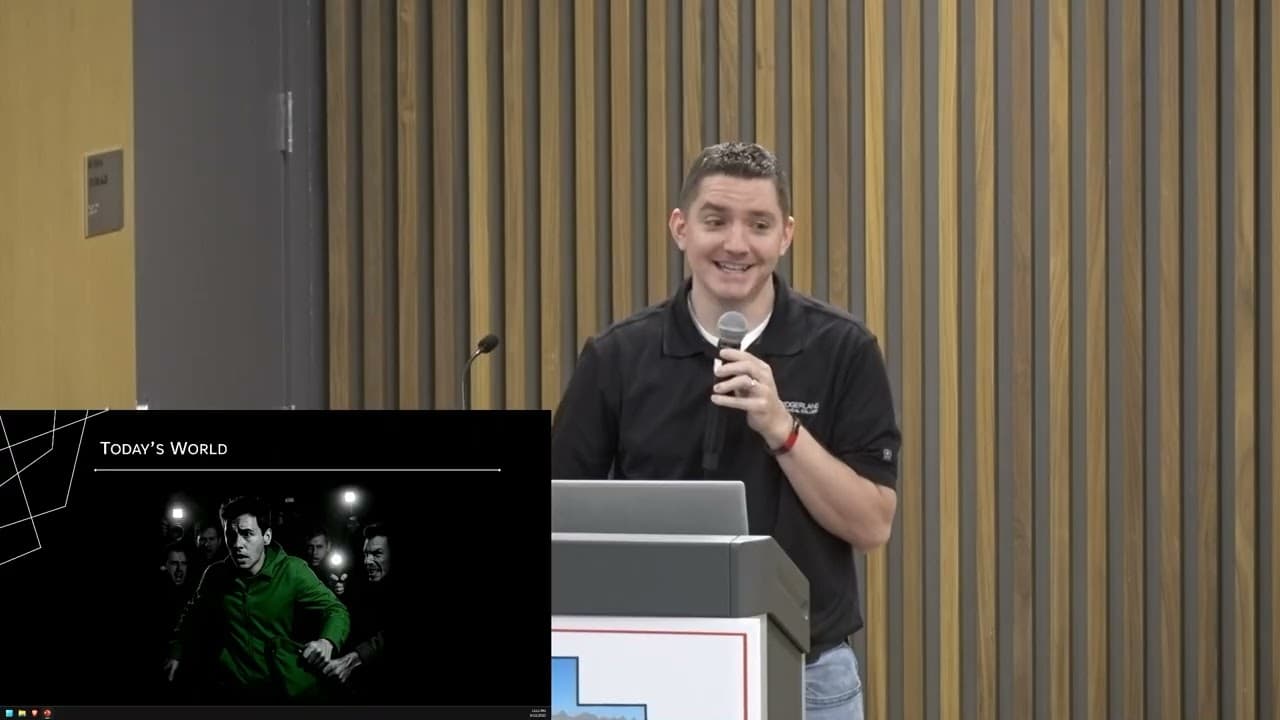
Synthetic Trust: The Future of Voice Cloning and Fraud
This talk demonstrates the practical application of generative AI for voice cloning and its use in sophisticated social engineering attacks. It highlights how voice authentication systems, such as those used by banks and government agencies, are vulnerable to synthetic audio impersonation. The presentation provides a 'fraud cookbook' detailing how attackers can automate the collection of voice samples and execute targeted scams. It concludes by proposing defensive strategies, including human-in-the-loop multi-factor authentication and the use of digital signatures for media verification.
The End of Voice Authentication: How Generative AI Makes Impersonation Trivial
TLDR: Modern voice authentication systems are fundamentally broken because they rely on static biometric patterns that are now trivial to synthesize with generative AI. Attackers can automate the collection of voice samples from social media and use tools like ElevenLabs to bypass bank and government security protocols. Pentesters should prioritize testing these voice-based MFA flows during engagements, as they are currently the weakest link in identity verification.
Voice authentication was supposed to be the future of secure, frictionless identity verification. Banks, government agencies, and telecom providers have spent years pushing customers toward "my voice is my password" as a secure alternative to knowledge-based authentication. That future arrived, but it brought a massive security debt that we are only now beginning to pay. The recent research presented at Black Hat 2023 confirms what many of us suspected: the barrier to entry for high-fidelity voice cloning has collapsed.
The Fraud Cookbook: From Social Media to Account Takeover
The core of the problem is that voice is no longer a secret. It is public data. Attackers do not need to compromise a server to get a target's voice; they just need to scrape a few seconds of audio from a public Instagram story, a YouTube interview, or a LinkedIn video. Once they have that sample, the technical process of cloning is remarkably straightforward.
The attack flow demonstrated in the research is a masterclass in low-effort, high-impact social engineering. First, the attacker identifies a target and scrapes their voice data. Second, they use ElevenLabs to generate a synthetic voice model. Third, they use a service like Slydial to route calls directly to the target's voicemail, ensuring they can capture the necessary audio prompts without the target ever picking up the phone. Finally, they use the cloned voice to call the target's bank or telecom provider, impersonating the victim to request sensitive information or authorize fraudulent transactions.
This is not a theoretical exploit. It is a direct abuse of OWASP A07:2021 – Identification and Authentication Failures. When a system treats a voice print as a static secret, it fails to account for the fact that the secret is easily reproducible.
Technical Realities of Synthetic Audio
The technical leap here is the shift from manual, time-intensive voice synthesis to automated, high-speed generation. Using models like Llama 2 or similar LLMs, an attacker can script the entire conversation flow, allowing the synthetic voice to respond dynamically to security questions.
Consider the following simplified Python snippet that represents how an attacker might structure the input for a voice synthesis API to maintain a consistent, conversational tone:
# Conceptual payload for voice synthesis
voice_config = {
    "voice_id": "cloned_target_id",
    "stability": 0.5,
    "similarity_boost": 0.8,
    "text": "I lost my card and need to verify my identity to reset my PIN."
}
The "stability" and "similarity" parameters are the keys to the kingdom. By tuning these, an attacker can ensure the output sounds natural enough to pass the automated checks used by many IVR (Interactive Voice Response) systems. These systems are often tuned to be permissive to avoid frustrating legitimate customers, which creates a massive window of opportunity for attackers.
Why Pentesters Must Target Voice Flows
If you are performing a red team engagement or a penetration test, stop skipping the voice authentication section of the scope. Most organizations treat their IVR systems as "out of scope" or "too difficult to test," which is exactly why they remain vulnerable.
During your next engagement, map out the voice authentication flow. Does the bank use a static passphrase? Does it rely on voice biometrics? If so, you have a clear path to exploitation. Use the same tools the researchers used. Scrape the target's public audio, build the model, and test the system's threshold for synthetic audio. You will likely find that the system is far less robust than the marketing materials suggest.
The Defensive Reality
Defenders cannot rely on the voice authentication systems themselves to detect these attacks. The cat-and-mouse game of AI-based detection versus AI-based generation is one that the attackers are currently winning. The only viable short-term defense is to implement a "human-in-the-loop" multi-factor authentication strategy.
If a caller requests a sensitive action, the system must require a secondary, out-of-band verification. This could be a push notification to a registered device, a time-based one-time password (TOTP), or a requirement to verify the request via a secondary, non-voice channel. If the organization insists on voice authentication, they must treat it as a low-assurance factor, never as a standalone method for high-value transactions.
We are entering an era where the sound of a voice is no longer proof of identity. If you are building or testing these systems, assume the voice is a lie. Verify everything else.
Vulnerability Classes
Tools Used
Target Technologies
OWASP Categories
Up Next From This Conference
Chained to Hit: Discovering New Vectors to Gain Remote and Root Access in SAP Enterprise Software
Zero-Touch-Pwn: Abusing Zoom's Zero Touch Provisioning for Remote Attacks on Desk Phones
ODDFuzz: Hunting Java Deserialization Gadget Chains via Structure-Aware Directed Greybox Fuzzing
Similar Talks
Inside the FBI's Secret Encrypted Phone Company 'Anom'
Kill List: Hacking an Assassination Site on the Dark Web