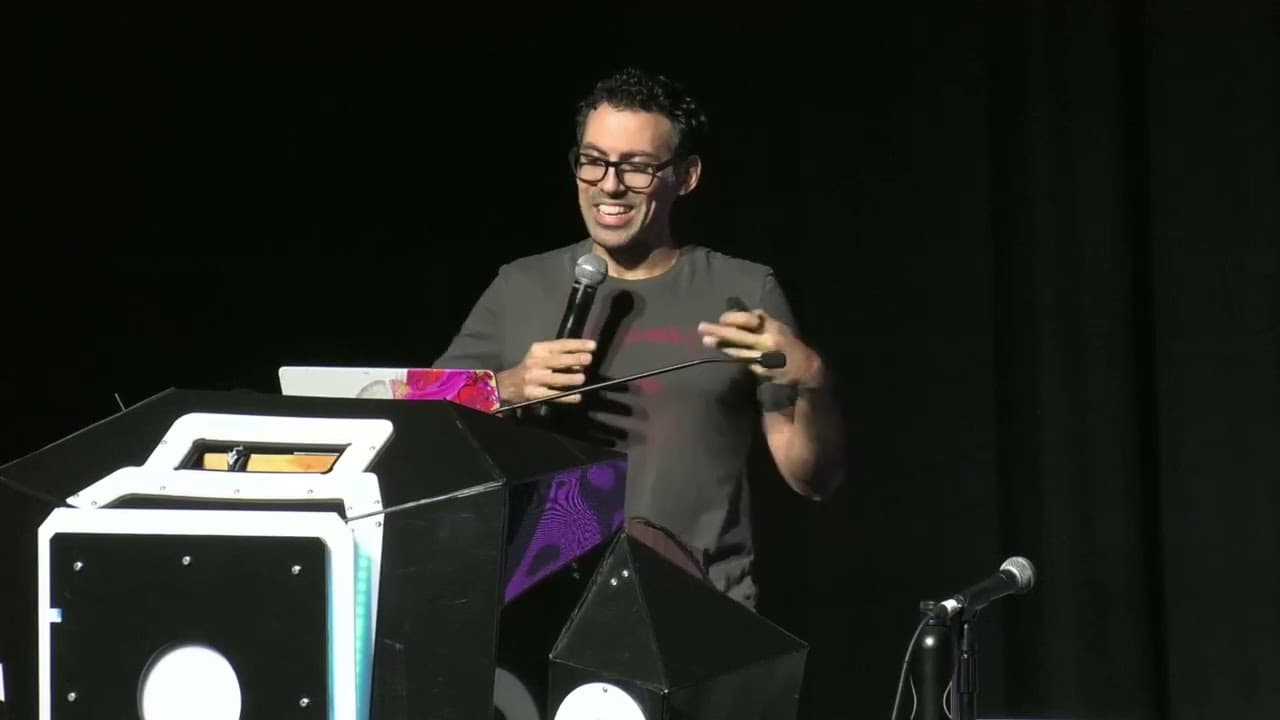
When Java Plays Unsafe: How A Single Mistake Can Break Memory Safety
This talk demonstrates how the use of the undocumented 'sun.misc.Unsafe' class in Java can bypass memory safety protections, leading to arbitrary memory access and potential data exfiltration. The speaker illustrates how this technique can be exploited in a REST API to dump JVM memory and recover sensitive information like AWS credentials. The presentation highlights the risks of using 'Unsafe' and advocates for migrating to the safer Foreign Function and Memory (FFM) API introduced in recent Java versions. The talk also provides guidance on using static analysis tools to detect and mitigate these dangerous code patterns.
How Java’s Hidden Unsafe Class Turns Memory Corruption into Data Exfiltration
TLDR: The
sun.misc.Unsafeclass in Java provides a dangerous backdoor that allows developers to bypass standard memory safety checks, enabling arbitrary memory access. This talk demonstrates how an attacker can exploit this in a REST API to dump JVM memory and extract sensitive data like AWS credentials. Pentesters should audit codebases forUnsafeusage and prioritize migrating to the modern Foreign Function and Memory API to eliminate these risks.
Memory safety is often treated as a binary state in the Java ecosystem. We assume that because the JVM manages our heap and stack, we are immune to the classic buffer overflows and use-after-free vulnerabilities that plague C and C++ applications. This assumption is dangerous. While the JVM provides a robust control plane, it also contains a massive, undocumented escape hatch: sun.misc.Unsafe.
This class was never intended for public consumption. It was designed for internal JDK use to perform low-level operations that require direct memory manipulation. Yet, a quick search on GitHub reveals tens of thousands of instances where developers have imported this class, often to squeeze out minor performance gains or to implement complex data structures. When you import sun.misc.Unsafe, you are effectively turning off the JVM’s safety features. You are telling the compiler that you know better than the runtime, and you are taking full responsibility for memory management.
The Mechanics of the Unsafe Exploit
The vulnerability arises because sun.misc.Unsafe provides methods like getByte, putByte, getLong, and putLong that operate on raw memory addresses. In a standard Java application, if you attempt to access an array index out of bounds, the JVM throws an ArrayIndexOutOfBoundsException. When you use Unsafe, those bounds checks simply do not exist. You are reading and writing to arbitrary memory locations within the process space.
Consider a REST API that accepts an integer index to retrieve data from an internal array. If the application uses Unsafe to access that array, an attacker can provide a negative index or an index far beyond the array's allocated size. The application will not crash with an exception; it will return whatever data happens to reside at that memory address.
In the demonstration provided, the speaker shows a Spring Boot application that uses Unsafe to manage a buffer. By sending a crafted request to the API, the attacker can read memory outside the intended buffer. Because the JVM heap contains both the application's code and its data, this memory dump can reveal sensitive objects, including hardcoded AWS credentials or session tokens stored in memory. This is a classic Information Disclosure scenario, but one that bypasses the language's primary security guarantees.
Identifying and Auditing Unsafe Usage
Finding these vulnerabilities during a penetration test requires a shift in how you approach static analysis. Most standard scanners are tuned to look for common web vulnerabilities like SQL injection or Cross-Site Scripting. They often ignore the presence of sun.misc.Unsafe because it is technically "valid" code.
To find these, you need to configure your static analysis tools to flag the import of sun.misc.Unsafe or its sibling jdk.internal.misc.Unsafe. If you are using Semgrep, you can write a custom rule to detect these imports across your entire codebase. Similarly, SonarQube and CodeQL can be configured to treat these imports as high-severity findings.
If you encounter Unsafe during an engagement, don't just report it as a "bad practice." Build a proof-of-concept that demonstrates the impact. Use curl to interact with the vulnerable endpoint and dump a portion of the heap. If you can recover a string, a configuration object, or a credential, you have a clear path to demonstrating a critical security failure.
The Path Forward: FFM API
The good news is that the Java community is finally addressing this. The Foreign Function and Memory (FFM) API provides a standardized, safe way to interact with memory outside the JVM heap. Unlike Unsafe, the FFM API enforces strict memory boundaries and lifecycle management. It allows you to allocate and free memory without the risk of arbitrary access.
If you are working with a development team that insists on using Unsafe for performance, challenge them. Ask for the benchmarks. In almost every case, the performance gains are negligible compared to the massive security debt they are incurring. If they must perform low-level memory operations, push them toward the FFM API. It is the only way to maintain the performance they desire while keeping the memory safety that makes Java a viable choice for enterprise applications.
For those of you performing code reviews, look for the sun.misc.Unsafe import. It is a red flag that indicates a lack of maturity in the codebase's memory management strategy. If you find it, you have found a potential entry point for an attacker to bypass the entire security model of the application. Treat it with the same urgency as a hardcoded password or a missing authentication check. The era of ignoring low-level memory corruption in high-level languages is over.
Vulnerability Classes
Target Technologies
Attack Techniques
OWASP Categories
Up Next From This Conference


Similar Talks

Kill List: Hacking an Assassination Site on the Dark Web
Exploiting Shadow Data in AI Models and Embeddings