Redefining the Origin of Secrecy in a Post-Quantum World
This talk introduces Reciprocal Kolmogorov Key Establishment (RKKE), a novel method for quantum-safe symmetric key distribution that leverages information-theoretic security rather than computational complexity. The technique utilizes correlated data sets and information reconciliation to establish shared secrets between parties while ensuring that any eavesdropping attempts are detectable. The speaker demonstrates how this approach provides a lightweight alternative to traditional key exchange protocols, particularly suitable for resource-constrained environments like IoT devices. The presentation highlights the theoretical underpinnings of entropy and Kolmogorov complexity in securing communications against future quantum threats.
Beyond Computational Complexity: Why Your Next Key Exchange Should Be Information-Theoretic
TLDR: Current key exchange protocols rely on computational hardness assumptions that quantum computers will eventually break. This research introduces Reciprocal Kolmogorov Key Establishment (RKKE), which secures symmetric keys using information-theoretic principles instead of math problems. By leveraging correlated datasets and information reconciliation, RKKE provides a quantum-safe, lightweight alternative for resource-constrained environments like IoT.
Quantum computing is no longer a theoretical threat for the next century. It is a looming deadline for every security engineer managing long-lived data. Most of our current infrastructure relies on asymmetric primitives like RSA or Elliptic Curve Diffie-Hellman. These rely on the assumption that factoring large integers or solving discrete logarithms is computationally infeasible. Once a sufficiently powerful quantum computer arrives, those assumptions evaporate. We are effectively building our houses on sand, waiting for the tide to come in.
The industry response has largely focused on Post-Quantum Cryptography (PQC) algorithms, which are essentially new, more complex math problems designed to be resistant to Shor’s algorithm. While necessary, these are still based on computational complexity. If someone finds a shortcut to solve these new lattice-based problems, we are back to square one. This is why the research presented at Black Hat Europe 2024 on Reciprocal Kolmogorov Key Establishment (RKKE) is so compelling. It shifts the goalposts from "this is too hard to compute" to "this is physically impossible to eavesdrop on."
The Mechanics of Information-Theoretic Security
RKKE abandons the idea of a "hard problem" and instead uses the properties of entropy and correlated data. Imagine two parties, Alice and Bob, who want to establish a shared secret. In a traditional setup, they exchange public keys and perform a handshake. An eavesdropper, Eve, captures this traffic and stores it, waiting for the day she has a quantum computer to decrypt it. This is the classic "harvest now, decrypt later" scenario.
RKKE changes the flow. Instead of exchanging keys, Alice and Bob receive correlated data from a source. Because this data is correlated, Alice and Bob can extract a shared secret from it. If Eve is listening, she also receives data, but because of the way the information is structured, she cannot extract the same secret. The security here is information-theoretic. Even with infinite computing power, Eve cannot recover the key because the information simply isn't present in her intercepted stream.
The core of this technique relies on the concept of distinguishability. Alice and Bob use a process to filter their datasets, keeping only the bits that are correlated between them. If Eve tries to interfere or intercept, she introduces noise that Alice and Bob can detect during their information reconciliation phase. This is the "Aha!" moment for a pentester: the security is not in the secrecy of the algorithm, but in the detectability of the eavesdropper.
Implementing the Reconciliation
In practice, the reconciliation process is surprisingly lightweight. It does not require the heavy lifting of modular exponentiation or complex point multiplication. Instead, it uses XOR operations and parity checks to align the datasets.
For a researcher or developer, the implementation looks more like a data synchronization task than a cryptographic one. You are essentially taking two noisy, correlated streams and distilling them into a single, clean key. The official documentation for similar information-theoretic approaches often emphasizes that the strength of these systems lies in the entropy source. If your entropy is weak, your key is weak.
The beauty of RKKE is its efficiency. Because the computational overhead is minimal, it is a perfect fit for IoT devices that struggle to perform standard RSA handshakes. If you are testing an IoT deployment, look for these types of lightweight, non-standard key exchange mechanisms. They are often implemented in custom firmware and are ripe for analysis. You aren't looking for a buffer overflow in a crypto library; you are looking for a flaw in the entropy source or the reconciliation logic.
Real-World Pentesting and Risk
During a penetration test, you rarely encounter information-theoretic key exchange today. However, as the industry pivots toward quantum-safe standards, you will see more "homegrown" or experimental implementations in critical infrastructure and embedded systems.
When you encounter a system claiming to be "quantum-safe," don't just check for the presence of PQC algorithms. Ask how the keys are established. If they are using a protocol that relies on a physical source of entropy or correlated noise, you need to evaluate the quality of that source. Can you influence the noise? Can you force the device into a state where the entropy is predictable?
The impact of a failure here is total. If the key establishment protocol is flawed, the entire encrypted session is compromised. Unlike a standard TLS implementation where you might look for CVE-2024-24789 or other common library vulnerabilities, you are auditing the fundamental logic of the key distribution.
Moving Forward
Defenders should focus on the integrity of their entropy sources. If you are building a system that uses RKKE or similar methods, your biggest risk is not a cryptanalytic attack on the math, but a physical attack on the sensor or the noise generator providing the correlated data.
For those of us in the field, this is a reminder that the future of security isn't just about bigger keys and harder math. It is about rethinking the physical and information-theoretic foundations of our protocols. Start looking at how your target applications handle key distribution. If they are moving away from standard PKI, you need to understand the underlying physics of their new approach. The next generation of bugs won't be in the math; they will be in the noise.
Tools Used
Target Technologies
Up Next From This Conference

BestFit: Unveiling Hidden Transformers in Windows ANSI
Wi-Fi Calling: Revealing Downgrade Attacks and Not-so-private Private Keys

The CVSS Deception: How We've Been Misled on Vulnerability Severity
Similar Talks
Inside the FBI's Secret Encrypted Phone Company 'Anom'
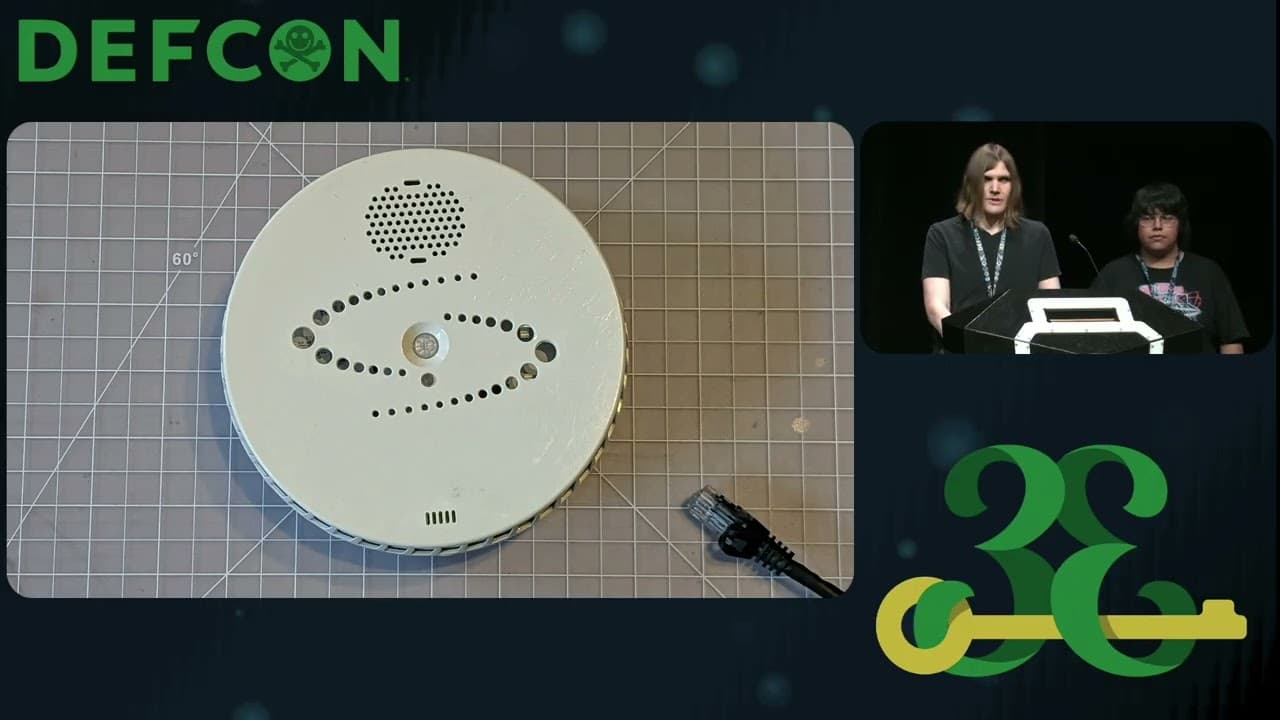
Unmasking the Snitch Puck: The Creepy IoT Surveillance Tech in the School Bathroom