If I Can Do It, So Can They: Lessons From Building A Phishing Simulation Tool And The Rise Of Phishing-as-a-Service
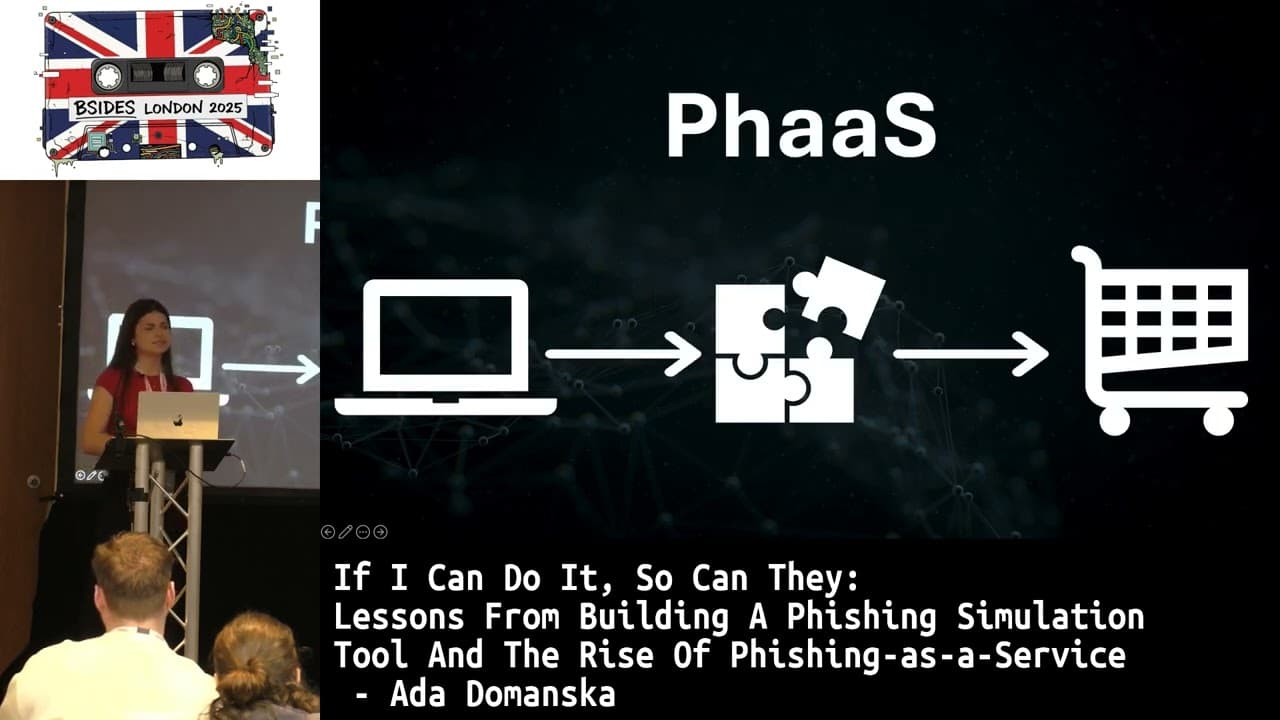
This talk explores the development of a custom phishing simulation tool and analyzes the growing threat of Phishing-as-a-Service (PhaaS) platforms. It details how attackers leverage social engineering techniques like urgency and authority to bypass multi-factor authentication (MFA) on platforms like Microsoft 365. The presentation highlights the shift from manual phishing to automated, scalable service models and emphasizes the importance of fostering a culture of psychological safety to improve organizational resilience. The speaker argues that technical controls alone are insufficient and that empowering employees to report suspicious activity is a critical defense mechanism.
Phishing-as-a-Service Platforms Are Turning Script Kiddies Into Advanced Persistent Threats
TLDR: Phishing-as-a-Service (PhaaS) platforms have commoditized complex social engineering, allowing low-skill attackers to execute sophisticated MFA-bypass campaigns at scale. These services provide pre-built infrastructure, templates, and evasion techniques that target modern authentication flows like Microsoft 365. Defenders must shift focus from purely technical controls to fostering a culture of psychological safety that encourages employees to report suspicious activity without fear of reprisal.
The barrier to entry for high-impact social engineering has collapsed. Where once a successful credential harvesting campaign required a dedicated infrastructure, custom-coded landing pages, and a deep understanding of session token theft, today’s attackers simply pay a subscription fee. Phishing-as-a-Service (PhaaS) platforms have turned what used to be a craft into a plug-and-play utility. This shift is not just about volume; it is about the sophistication of the attacks being delivered to the average user.
The Mechanics of Modern Phishing
Modern phishing is no longer about convincing a user to enter their password into a fake login form. That approach fails against any organization with basic multi-factor authentication (MFA) enabled. Instead, current campaigns focus on T1556.006 by intercepting session tokens. Tools like Evilginx have become the industry standard for this, acting as a transparent reverse proxy between the victim and the legitimate service.
When a user clicks a link in a phishing email, they are directed to a proxy server that mirrors the real login page. As the user enters their credentials and completes the MFA challenge, the proxy captures the session cookie. The attacker then imports this cookie into their own browser, effectively bypassing the need for the password or the second factor entirely.
PhaaS platforms have taken this technical complexity and wrapped it in a user-friendly dashboard. A subscriber does not need to know how to configure Nginx or manage SSL certificates. They simply select a target, choose a template, and the platform handles the rest. This includes automated evasion techniques, such as geofencing to block security scanners or rotating domains to avoid reputation-based blacklists.
The Shift to Automated Evasion
The most dangerous aspect of these platforms is their ability to adapt to new communication channels. Attackers are moving beyond email, targeting users via iMessage and RCS. By leveraging the inherent trust users place in mobile messaging, they increase the likelihood of a click.
Consider the workflow of a typical PhaaS-driven attack:
- Infrastructure Provisioning: The attacker selects a pre-configured campaign targeting a specific SaaS provider.
- Template Injection: The platform generates a dynamic, personalized landing page that mimics the target’s corporate branding.
- Delivery: The attacker uses the platform’s built-in SMS or email delivery service to send the lure.
- Session Capture: The platform’s backend captures the session token and alerts the attacker via a Telegram bot or a custom dashboard.
This automation allows a single operator to manage hundreds of concurrent campaigns. The ENISA Threat Landscape 2025 report confirms this trend, noting that platforms like Tycoon 2FA have become dominant in the landscape, accounting for the vast majority of observed PhaaS-based MFA bypass attempts.
Why Technical Controls Are Not Enough
Pentesters often focus on the technical failure points, such as misconfigured OWASP A07:2021 – Identification and Authentication Failures. While hardening authentication is necessary, it is not sufficient. If an attacker can trick a user into handing over a session token, the strongest MFA in the world will not stop them.
The real battlefield is human psychology. Attackers exploit urgency and authority to bypass critical thinking. When a user receives an alert claiming their account will be locked in 24 hours, the fear of losing access overrides their suspicion. This is where the defensive strategy must evolve.
Organizations that rely solely on technical blocks create a culture of blame. If a user clicks a link, they are punished, which leads to silence. Silence is the attacker’s best friend. If an employee clicks a link but is afraid to report it, the attacker has hours or days to move laterally through the network.
Building Resilience Through Culture
Defenders need to prioritize psychological safety. This means moving away from "gotcha" phishing simulations that shame employees and toward a model that rewards transparency.
A resilient organization implements three core shifts:
- Normalize Reporting: Leaders should publicly thank employees for reporting suspicious emails, even if they turn out to be false alarms.
- No-Blame Policies: Make it clear that reporting a mistake—even a click—is the right thing to do and will not result in disciplinary action.
- Near-Miss Conversations: Use real-world phishing attempts as teaching moments. When a user reports a suspicious message, share the details with the team to build collective awareness.
Technical controls are the foundation, but they are static. An attacker can always find a way to bypass a filter or a proxy. A culture of curiosity, where employees feel empowered to ask "Does this look right?" before they click, is dynamic. It is the only defense that scales as quickly as the threats themselves.
Stop trying to patch the user. Start building a team that treats security as a shared responsibility rather than a corporate mandate. The next time you are on an engagement, look beyond the technical vulnerabilities and assess the reporting culture. You will likely find that the most effective way to stop an attacker is to make the environment so transparent that their deception has nowhere to hide.
Vulnerability Classes
Target Technologies
Attack Techniques
OWASP Categories
Up Next From This Conference
From Chaos to Calm: Mastering InfoSec Audits
Beginner's Guide To Malicious Browser Extensions