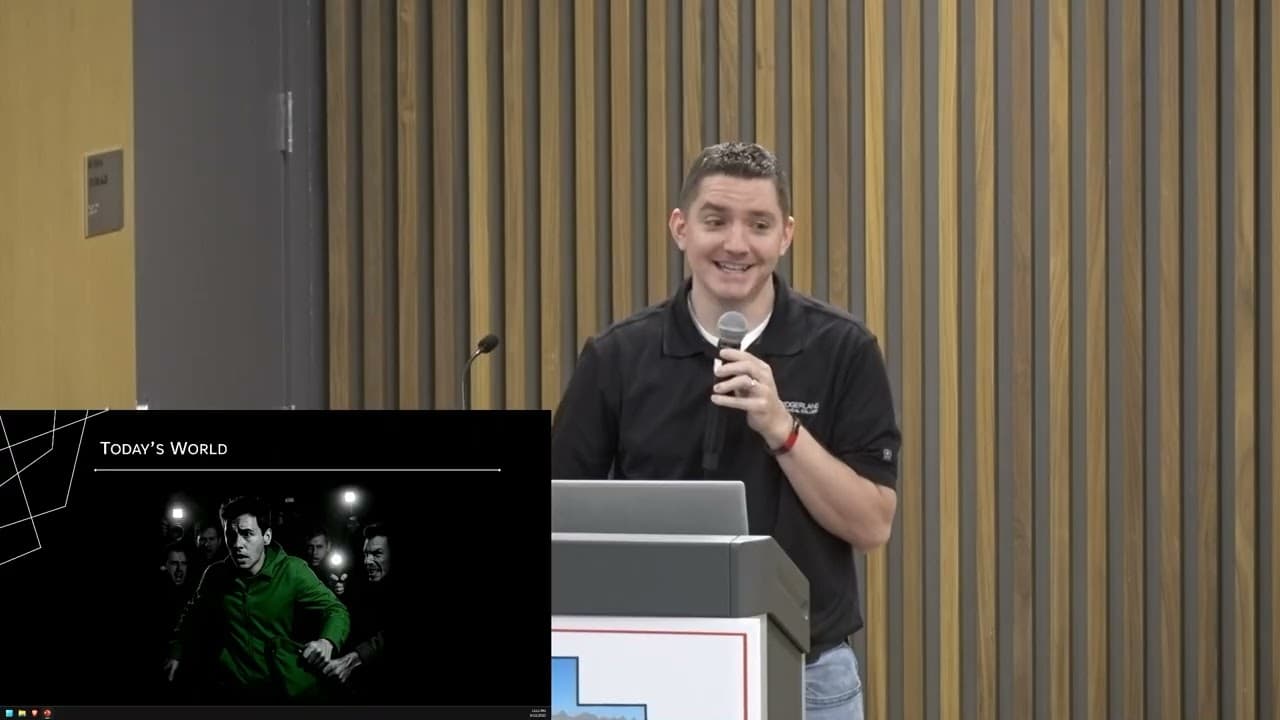
Preparing for Dragons: Don't Sharpen Swords, Set Traps, and Gather Supplies
This talk advocates for a shift from reactive, threat-specific security to a proactive, resilience-based defense strategy. It emphasizes prioritizing fundamental security hygiene, such as reducing attack surfaces and implementing robust asset management, over chasing the latest high-profile vulnerabilities. The speaker demonstrates how to leverage deception techniques like honeypots and honeytokens to gain early detection of unauthorized activity. The presentation concludes with a framework for continuous process improvement based on lessons learned from incident response and industry reports.
Stop Chasing Zero-Days and Start Hardening Your Infrastructure
TLDR: Most security teams waste time chasing high-profile vulnerabilities while ignoring the low-hanging fruit that actually leads to compromise. This talk argues for a shift toward proactive resilience, focusing on reducing attack surfaces and using Canarytokens for early detection. By prioritizing fundamental hygiene over reactive patching, you can stop attackers before they even reach your critical assets.
Security conferences are often echo chambers for the latest "critical" CVEs. We spend weeks obsessing over the newest remote code execution flaw in a library we might not even use, while our perimeter remains riddled with default credentials and exposed management interfaces. This isn't just a failure of process; it is a failure of focus. If you want to actually move the needle on your security, you need to stop sharpening your sword for a dragon that isn't there and start setting traps for the ones that are.
The Myth of the Sophisticated Attacker
Most of the breaches I analyze don't involve a nation-state actor burning a zero-day to bypass a complex authentication scheme. They look like a mediocre penetration test from 2010. Attackers are lazy, and they don't need to be sophisticated when they can just walk through the front door. They are looking for Security Misconfiguration and Vulnerable and Outdated Components.
When you look at the Verizon Data Breach Investigations Report, the data is clear. A massive percentage of incidents stem from basic failures: unpatched legacy hardware, exposed VPNs, and default credentials on internal infrastructure. These aren't technical mysteries. They are operational failures. If you are spending your entire budget on threat intelligence feeds for the latest APT, but your team hasn't audited your external-facing web servers for unnecessary services, you are doing it wrong.
Reducing the Attack Surface
The most effective way to secure a system is to remove the parts of it that don't need to exist. Every service running on a server is a potential vector. Every open port is a liability. If your web server is running a printing service, you have already lost the battle.
Start by auditing your environment. If you are a pentester, this is the first thing you should be doing during your reconnaissance phase. Use tools to map out exactly what is exposed. If you find a service that shouldn't be there, it’s a finding. If you find a default configuration, it’s a finding.
# Example of a basic service audit
nmap -sV -p- <target_ip>
When you remove these services, you aren't just patching a hole; you are removing the hole entirely. This is the difference between a reactive posture and a resilient one. A resilient system is one that is difficult to attack because there is simply less to attack.
Deception as a Force Multiplier
Once you have cleaned up your environment, you need to know when someone is poking around. This is where deception comes in. Most organizations have no idea they are being scanned until the attacker has already achieved persistence.
Deploying Canarytokens is one of the highest-ROI activities you can perform. By placing a fake file, a honeytoken, or a dummy credential in your environment, you create a tripwire. If an attacker touches that file, you get an alert. It’s that simple. You don't need a massive budget or a team of PhDs to implement this. You just need to be smarter than the attacker.
If you are a researcher, start using these in your own environments. If you are a pentester, suggest them to your clients. It changes the game from "how do I find the attacker" to "the attacker just told me exactly where they are."
Prioritizing the Fundamentals
We need to stop treating security as a series of disconnected, high-intensity events. It is a process of continuous improvement. When you see a breach report, don't just look for the CVE. Look for the process failure that allowed that CVE to be exploited. Was the asset management system broken? Was the patching cycle too slow? Did the team lack visibility into that specific segment of the network?
If you want to build a truly resilient organization, you have to get the basics right. This means:
- Asset Management: You cannot protect what you do not know you have.
- Access Control: If an employee leaves, their access must be revoked immediately.
- Process Improvement: Every incident is a data point. Use it to refine your defenses.
The industry is obsessed with the "threat of the day," but the reality is that the threats don't change as fast as the marketing departments would have you believe. The same techniques that worked five years ago are still working today because we are still making the same mistakes. Stop chasing the dragon. Start chopping wood and carrying water. Your security will be better for it.
Vulnerability Classes
Tools Used
Target Technologies
Attack Techniques
Up Next From This Conference
Similar Talks
Inside the FBI's Secret Encrypted Phone Company 'Anom'

Kill List: Hacking an Assassination Site on the Dark Web