DEF CON 33 Recon Village - Investigating Foreign Tech from Online Retailers - Michael Portera
Description
Michael Portera investigates the security and supply chain of cheap smartwatches sold on Amazon. He demonstrates how to use OSINT to track mysterious brand owners, hardware teardowns to identify chipsets, and MobSF to uncover privacy risks in companion Android apps.
Title: The Hidden Cost of $30 Tech: Investigating Amazon's Ghost Brands and Shady Smartwatches
Introduction: In an era of rising inflation and the constant allure of digital gadgets, the impulse to 'buy cheap' on Amazon is stronger than ever. We have all seen them: smartwatches, power banks, and home cameras with brands that look like someone fell asleep on a keyboard—brands like 'RUXINGEG' or 'FOSMEP.' But beyond the strange names lies a complex web of shell companies, recycled hardware, and significant privacy risks. In a compelling talk at DEF CON 33, Michael Portera (VP of Cyber Solutions at Sequoia) demonstrated why these budget purchases might be costing you much more than thirty dollars. This post will walk through the OSINT, hardware, and mobile analysis techniques used to unmask the reality of foreign tech on major retail platforms.
Background & Context: Amazon's marketplace is currently dominated by Chinese sellers, making up approximately 50% of the top 10,000 accounts. Since Amazon began requiring trademarks in 2015 to combat quality issues, sellers have flooded the U.S. Patent and Trademark Office with nonsense names. These random letter strings are easily approved, allowing sellers to 'white-label' generic products rapidly. If one brand gets banned for fake reviews or safety violations, they simply pivot to the next trademarked string. This creates a supply chain nightmare for security-conscious consumers and organizations alike. The risk isn't just a device that catches fire; it's a device that functions as a data-harvesting node on your wrist.
Technical Deep Dive:
OSINT: Tracking the 'Ruxing Eggs' Rabbit Hole
The investigation starts with the brand itself. Using the brand name 'Ruxing Eggs,' Portera tracked the trademark to a registrant in China. However, the registered address was a soccer field. This is a classic hallmark of a shell operation. By pivoting to the attorney of record, a pattern emerged: a single lawyer in Los Angeles had filed thousands of these nonsense trademarks.
Tools like Import Yeti and Pangeva are invaluable here. They allow researchers to view shipping manifests and bill of lading data. By searching for the manufacturer names found in the FCC filings, you can see exactly where these products land in the U.S. and which 'brands' are receiving them. This mapping reveals that dozens of 'unique' Amazon products are actually identical units rolling off the same assembly line in Shenzhen.
Hardware Analysis: The FCC ID Goldmine
Before even opening a device, you should check its FCC ID. Any electronic device that emits RF must be registered. These public filings often contain internal photos, block diagrams, and confidentiality requests. In this case, the smartwatch used a Realtek chipset and Buya Semi firmware. While Realtek is a standard Taiwanese manufacturer, the documentation showed that the 'G35' model was virtually identical to the 'K35' and 'T35' models sold by different brands.
For the hands-on phase, a teardown revealed the simplified architecture of budget wearables: a Bluetooth SoC, an accelerometer, a heart rate sensor, and a small battery. Portera warns that while the hardware itself may not look malicious, the lack of firmware signing and the ability to easily interface with the battery pads (even with some messy soldering) means the security of the physical device is non-existent.
Mobile Security: The Data Drain
The real 'smoking gun' was found in the companion Android app, DeepFit. Portera used Mobile Security Framework (MobSF) to analyze the APK. If you want to perform this yourself, running MobSF in a Docker container is the most efficient method.
Findings from MobSF revealed:
- Invasive Permissions: The app requested
ACCESS_BACKGROUND_LOCATION,READ_CALL_LOG, andREAD_SMS—far more than a $30 watch needs for basic functionality. - Cleartext Traffic: The app failed to use HTTPS for several critical data transfers. Using dynamic analysis, Portera observed traffic being sent in the clear.
- Foreign Infrastructure: The app was hardcoded to communicate with servers owned by
QQ.comand other Chinese entities. Every step you take and every heart rate spike recorded is transmitted directly to foreign servers without encryption.
Mitigation & Defense:
Defending against these risks requires a 'Zero Trust' approach to consumer hardware. First, avoid using companion apps for off-brand devices on your primary smartphone. If you must use them, utilize 'Work Profiles' on Android to isolate the app's access to your data. Secondly, always check the FCC ID and research the brand on the Consumer Product Safety Commission website. For organizations, implementing a strict BYOD (Bring Your Own Device) policy that bans non-vetted wearables is essential to prevent data leakage from sensitive environments.
Conclusion & Key Takeaways:
Michael Portera's research proves that 'cheap' tech is often a trade-off for personal data. The ecosystem of Amazon's third-party sellers is designed to be opaque, making it easy to hide the true destination of your health and location information. The key takeaway for security professionals and hobbyists is the power of toolsets like MobSF and the FCC Database to pull back the curtain. Always remember: if you aren't paying for the product's security, you (and your data) are the product. Practice safe OSINT, and think twice before clicking 'Buy Now' on that suspiciously cheap gadget.
AI Summary
In this DEF CON 33 Recon Village presentation, Michael Portera, VP of Cyber Solutions at Sequoia (Secure INC), explores the security implications of purchasing low-cost 'foreign tech' from online retailers like Amazon. The talk centers on the 'Amazon Chinese seller issue,' where thousands of brands with nonsensical, random-letter names flood the marketplace. Portera explains that this is a deliberate strategy to bypass trademark due diligence, as unique random strings are more likely to be auto-stamped by the US Patent and Trademark Office. The methodology begins with OSINT (Open Source Intelligence). Portera targets a specific smartwatch brand, 'Ruxing Eggs,' tracing its trademark to a physical address that turns out to be a soccer field in China. He identifies a prolific trademark attorney in Los Angeles, 'Anson' (Xenin Liu), who has filed over 1,600 trademarks for similar entities. By pivoting through email addresses (VIP@VIPASG.com) and WhatsApp numbers, he uncovers a network of interconnected companies (Seaway Upen, FOSMEP) that white-label identical hardware under different brand names. This section highlights how difficult it is for consumers to perform due diligence on the products they bring into their homes. Portera then moves to hardware analysis. He emphasizes the value of the FCC ID database, which requires any device emitting RF signals over 9kHz to be registered. These reports provide internal circuit board photos and manufacturer details (often from Shenzhen). He performs a physical teardown of the watch, identifying components from Realtek and Buya Semi. While no overt hardware backdoors were discovered, he notes the extreme budget nature of the build. He also shares a humorous 'fail' where he accidentally damaged the soldering pads during firmware extraction, serving as a realistic reminder of the challenges in hardware reverse engineering. The final and most alarming phase of the research focuses on the companion Android application, 'DeepFit.' Using the Mobile Security Framework (MobSF) in a Docker container, Portera performs static and dynamic analysis on the APK. He discovers that the app requests invasive permissions, including background location and call management. Most significantly, the analysis reveals that the app transmits data in cleartext (unencrypted) to various Chinese infrastructure endpoints, specifically involving QQ servers. Portera concludes that while the hardware might be functional, the hidden cost of these $30 devices is the user's privacy, as sensitive health and location data are sent across the globe without basic security protections.
More from this Playlist
DEF CON 33 Recon Village - Mapping the Shadow War From Estonia to Ukraine - Evgueni Erchov
DEF CON 33 Recon Village - How to Become One of Them: Deep Cover Ops - Sean Jones, Kaloyan Ivanov
DEF CON 33 Recon Village - Building Local Knowledge Graphs for OSINT - Donald Pellegrino
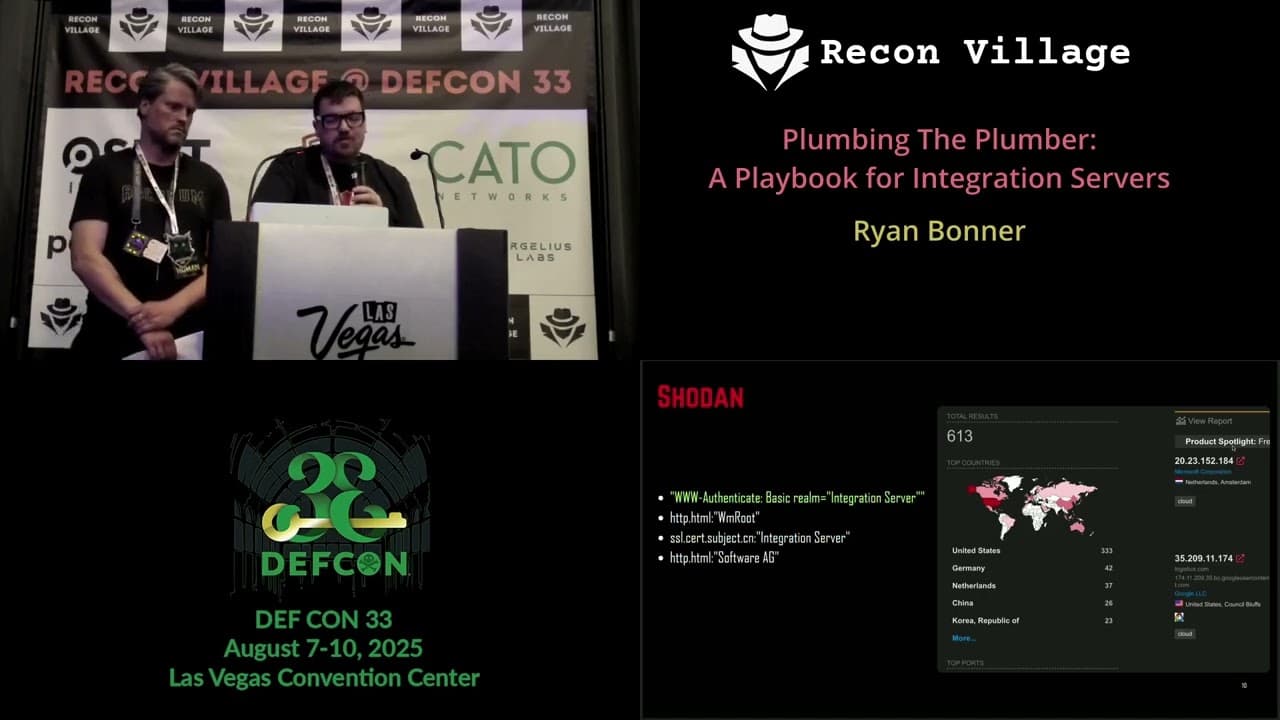
DEF CON 33 Recon Village - A Playbook for Integration Servers - Ryan Bonner, Guðmundur Karlsson