DEF CON 33 Recon Village - OSINT Signals Pop Quiz - Master Chen
Description
Master Chen presents an engaging session on the art of OSINT signaling, teaching researchers how to decode non-verbal cues and cultural symbols. The presentation uses a practical pop quiz to demonstrate how clothing, handshakes, and physical objects reveal organizational affiliations and hidden contexts.
Title: Beyond Geolocation: Decoding the Secret Language of OSINT Signals\n\nIntroduction\nIn the world of Open Source Intelligence (OSINT), we often find ourselves obsessed with the technical: the latitude and longitude of a photograph, the EXIF data hidden in a JPEG, or the exact species of flora in a background to pinpoint a region. However, as Master Chen demonstrated at DEF CON 33's Recon Village, the most valuable data is often staring us in the face, hidden within the cultural and psychological signals people intentionally or unintentionally broadcast. This blog post explores the 'OSINT Signals' framework, a methodology for decoding human behavior and affiliation that is essential for any serious red teamer, social engineer, or intelligence analyst. By training your eyes to see these signals, you move from merely observing data to truly understanding human context.\n\nBackground & Context\nSignaling is a fundamental human behavior used to express intention, organizational affiliation, or a desire to communicate. Master Chen’s approach combines three distinct pillars: martial arts (physical discipline), hacking (technical curiosity), and psychology (behavioral analysis). In the current security landscape, where privacy-conscious targets may scrub their metadata, visual signaling remains a persistent leak. People naturally want to belong to groups, and that belonging is expressed through clothing, gestures, and artifacts. Understanding these signals allows an investigator to build a profile of a target’s history, rank, and affiliations without ever touching a computer. This 'Human OSINT' or HUMINT-lite provides the narrative that bridges the gap between raw data and actionable intelligence.\n\nTechnical Deep Dive: The Hierarchy of Signaling\nChen categorizes signaling into four distinct levels of specificity, which can be visualized as a descending triangle. Understanding where a signal falls on this spectrum helps an analyst determine the target's intent and level of discretion.\n\nUnderstanding the Signaling Levels:\n1. Overt Signaling: This is the broadest category. It includes public displays meant for everyone to see, such as political bumper stickers, 'vegan' t-shirts, or nationalist flags. These indicate broad identity and values.\n2. Organizational/Institutional Signaling: This level identifies specific group membership. It involves logos, brand-specific merchandise (like DEF CON merch), and professional uniforms. These signals help verify a target's employment or social circles.\n3. Secret Signaling: These are signals meant for 'those who know.' This includes Masonic handshakes, specific jewelry associated with fraternal organizations, or the placement of pins that signify rank within a niche group. They are designed to be missed by the general public but recognized by peers.\n4. Covert Signaling: This is the most tactical level. It involves pre-arranged, seemingly mundane actions that carry high-value meaning. For example, wearing a watch on the right wrist instead of the left to signal a meeting is compromised, or a 'dead drop' signal in physical space. These are rarely identifiable without prior knowledge or long-term surveillance.\n\nCase Studies in Decoding Signals:\nMaster Chen’s 'Pop Quiz' provided several high-value examples of how these signals manifest in the real world:\n- The Tiare Flower: In Polynesian culture, a flower behind the left ear indicates the wearer is taken/married, while the right ear signals they are single. For an OSINT investigator, this instantly provides marital status without a public records search.\n- The Italian 'Traitor's Pour': Pouring wine with the palm facing up (overhand) vs. underhand can signify in-group vs. out-group status in traditional Italian social contexts. In certain underworld contexts, the 'underhand pour' or 'fujot' signifies a warning that someone is not to be trusted.\n- Military Coinage: Finding coins on a veteran's headstone is not random. A penny means you visited; a nickel means you were in boot camp together; a dime means you served with them; and a quarter means you were present when they died. This provides a detailed map of a veteran's surviving social network.\n- Subculture Codes: The 'Hanky Code' (handkerchiefs in back pockets) and 'Lace Code' (colored shoelaces on combat boots) are legacy signals from various subcultures (LGBTQ+, Skinhead, etc.) that indicate specific preferences, roles, or even a history of violence (e.g., red laces in certain contexts signifying blood shed for the movement).\n\nMitigation & Defense\nFrom a defense or 'Counter-OSINT' perspective, the primary lesson is signal discipline. If you are operating in a high-security environment or conducting sensitive research, you must be hyper-aware of what your appearance and surroundings broadcast. To mitigate your own signal leak, adopt a 'gray man' philosophy: avoid logos, unique jewelry, or cultural identifiers. For defenders, recognizing these signals is a powerful detection tool. An individual wearing 'overt' signals of one group while attempting to infiltrate another is a massive red flag. Training security personnel to recognize the 'Masonic handshake' or 'duress flags' can prevent unauthorized access and identify threats before they escalate.\n\nConclusion & Key Takeaways\nMaster Chen’s presentation at Recon Village serves as a vital reminder that OSINT is as much about people as it is about packets. The ability to decode the visual shorthand of human culture is a superpower in reconnaissance. Key takeaways include the importance of cross-cultural literacy, the hierarchy of signaling specificity, and the need to look beyond the metadata. As you conduct your next investigation, ask yourself: 'What is this person's clothing telling me about their history? What does that handshake say about their network?' Practice these skills in public spaces safely and ethically. By mastering the art of the signal, you become a more holistic and effective security professional.
AI Summary
Master Chen, a multifaceted professional with backgrounds in martial arts, hacking, and psychology, presents a unique session at DEF CON 33's Recon Village titled 'OSINT Signals Pop Quiz.' The core objective of the talk is to move beyond the traditional technical aspects of Open Source Intelligence (OSINT)—such as geolocation, metadata, and shadow analysis—and focus on the human and cultural signals often hidden in plain sight. Chen introduces a hierarchical framework for understanding signaling, visualized as a triangle that increases in specificity as it narrows: Overt, Organizational/Institutional, Secret, and Covert. Overt signaling includes obvious displays like t-shirts, flags, and bumper stickers meant for general consumption. Organizational signals identify membership in specific groups through logos or brands. Secret signals involve more niche identifiers like handshakes or the specific placement of insignias. Covert signaling is the most direct and discreet, often involving pre-arranged, nonchalant actions meant only for specific recipients. The bulk of the presentation is an interactive pop quiz where Chen challenges the audience to identify the meaning of various visual signals. Examples include the placement of flowers in hair (indicating relationship status in Polynesian cultures), the positioning of a wedding ring, and the 'Masonic handshake' used by secret societies. The quiz delves into more obscure areas like the 'Hanky Code' used in subcultures to indicate specific interests or roles, and 'Lace Code' within skinhead subcultures, where lace color can signify a willingness to commit violence. Chen also covers political and historical signals, such as an upside-down Hawaiian flag signifying distress or independence movements, and military traditions involving leaving specific denominations of coins on gravestones to indicate the visitor's relationship to the deceased. The session concludes with a call to OSINT researchers to pay closer attention to the 'who' and 'why' behind the visual data they encounter, emphasizing that understanding the cultural and psychological context of an image is just as critical as its technical coordinates.
More from this Playlist
DEF CON 33 Recon Village - Mapping the Shadow War From Estonia to Ukraine - Evgueni Erchov
DEF CON 33 Recon Village - How to Become One of Them: Deep Cover Ops - Sean Jones, Kaloyan Ivanov
DEF CON 33 Recon Village - Building Local Knowledge Graphs for OSINT - Donald Pellegrino
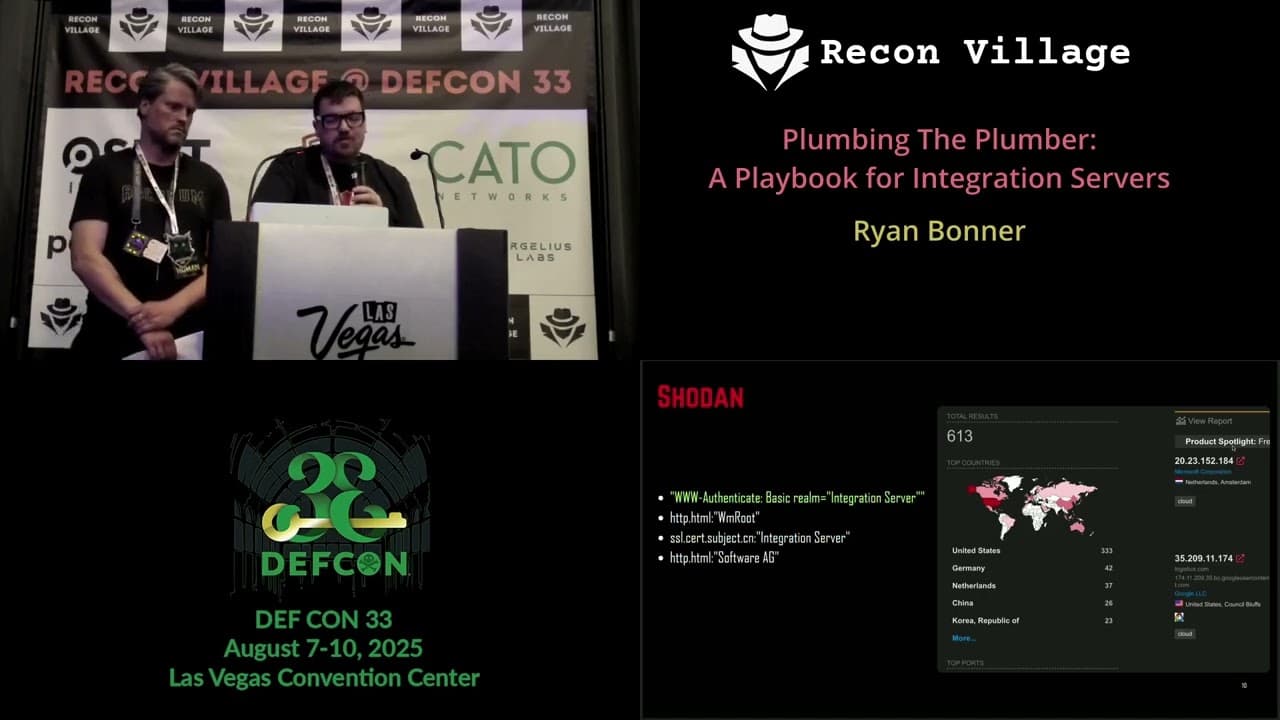
DEF CON 33 Recon Village - A Playbook for Integration Servers - Ryan Bonner, Guðmundur Karlsson