Smishmash - Text Based 2fa Spoofing Using OSINT, Phishing Techniques and a Burner Phone
Description
Researchers demonstrate SmishMash, a technique that leverages massive data leaks to link phone numbers to email addresses for targeted smishing. The presentation explores how attackers bypass text-based 2FA using spoofed SMS senders and adversary-in-the-middle proxies.
Title: SmishMash: Why Your Phone Number is the Weakest Link in Your Security
Introduction: In the world of cybersecurity, we have long been told that Two-Factor Authentication (2FA) is the silver bullet for account security. However, not all 2FA is created equal. At Black Hat USA 2022, researchers Thomas Olofsson and Mikael Byström unveiled 'SmishMash,' a devastatingly effective attack methodology that proves text-based 2FA is no longer a reliable line of defense. By combining massive OSINT data sets with traditional phishing and modern proxy techniques, attackers are bypassing the security of major crypto exchanges and tech giants with ease. This post explores how the 'SmishMash' technique works and why it is time to retire SMS for security.
Background & Context: The current security landscape is defined by the 'leak fatigue'—the constant stream of data breaches from companies like LinkedIn, Twitter, and Facebook. While we often focus on leaked passwords, these breaches have leaked billions of phone numbers. Historically, phone numbers were seen as isolated identifiers, but the SmishMash research demonstrates that these numbers are now the 'glue' connecting disparate data leaks. By indexing these breaches, the researchers established that 20% of all leaked emails can be directly mapped to a specific phone number. This mapping allows an attacker to move from a generic phishing attempt to a highly targeted 'smishing' campaign with a significantly higher trust factor and success rate.
Technical Deep Dive:
The Data Indexing Engine
The foundation of the attack is a massive Elasticsearch instance containing over 500 million indexed records. By correlating data from 'Breach Forums' and ransomware leak sites, the researchers can perform reverse lookups. If an attacker has your email, they can find your phone number; if they have your phone number, they can find every service where you have used that number. This 'All your numbers are belong to us' approach transforms static leak data into an actionable intelligence platform.
Exploiting the SMS Protocol (SS7/GSM)
The technical root of the problem lies in the age of the SMS protocol. Developed in the 1980s, SMS was never intended for security. It is essentially 7-bit ASCII text sent over the signaling channel with zero encryption or sender verification. Using AT commands (Attention commands) on old hardware like a Nokia N900 or modern API-based SMS gateways, an attacker can set the alphanumeric 'Sender ID' to anything—'Google', 'Apple', or 'IRS'. Because phones group messages by Sender ID, the phishing message appears in the same thread as legitimate past communications from that service.
Step-by-Step SmishMash Execution
- Reconnaissance: The attacker uses the Elasticsearch DB to link a victim's email to their phone number and identifies which services (e.g., Binance) they likely use.
- The Lure: A spoofed SMS is sent to the victim, often claiming 'suspicious activity' or 'account lock,' providing a link to a fraudulent domain (e.g.,
binance-security-check.com). - Adversary-in-the-Middle (AiTM): The link leads to a reverse proxy. When the victim enters their credentials, the proxy forwards them to the real site in real-time.
- 2FA Trigger: The real site sends a genuine 2FA code to the victim's phone.
- The Trap: Because the mobile OS recognizes the incoming 2FA code, it often suggests 'Auto-fill' for the victim. The victim clicks the auto-fill, providing the real code to the attacker's proxy.
- Session Hijacking: The attacker captures the resulting session cookie, gaining full access to the account while the victim is redirected back to the legitimate site, often unaware they have been breached.
Mitigation & Defense: To defend against SmishMash, organizations must acknowledge that SMS is a 'leaky' medium. Detection is difficult because the attack happens at the protocol and user-interface levels. For defenders, implementing Recaptcha (which can be tied to specific domains) and monitoring for AiTM signatures can help. However, the only true solution is to migrate users away from SMS 2FA. Best practices now dictate the use of TOTP apps (like Google Authenticator) or, ideally, hardware security keys (FIDO2/WebAuthn) which are inherently resistant to proxy-based phishing because the cryptographic handshake is tied to the specific browser domain.
Conclusion & Key Takeaways: The SmishMash research serves as a stark reminder that legacy protocols like SMS cannot support modern security requirements. The ability to link OSINT data to phone numbers has made smishing the new frontline of account takeover. Users should treat every unsolicited text message with extreme skepticism, even if it appears in a 'trusted' thread. For developers, the message is clear: stop relying on the phone network as a root of trust. It is time to move toward a passwordless, hardware-backed future to stay ahead of the SmishMashers.
AI Summary
At Black Hat USA 2022, Thomas Olofsson and Mikael Byström presented 'SmishMash,' a study on the weaponization of leaked credentials and phone numbers to bypass SMS-based two-factor authentication (2FA). The researchers highlight a critical shift in the threat landscape: while attackers previously focused on usernames and passwords, the explosion of data leaks (including Facebook, LinkedIn, and Drizly) has provided a massive repository of phone numbers that can now be linked to specific identities. By indexing over 500 million records into an Elasticsearch database, the team found they could tie roughly 1 in 5 email addresses to a valid phone number, creating a powerful starting point for targeted attacks. The core of the SmishMash technique involves 'Smishing' (SMS phishing) combined with Adversary-in-the-Middle (AiTM) proxies. Because the SMS protocol (standardized in 1984) lacks inherent security, sender verification, or checksums, it is trivial for attackers to spoof the 'Sender ID.' An attacker can send a message that appears to come from 'Binance,' 'Google,' or 'Verizon' simply by using common API providers or specialized hardware like GSM modems. The presentation details how these messages are used to lure victims to a proxy site that mimics a legitimate login page. One of the most striking findings is how mobile browser behavior inadvertently assists attackers. Modern mobile browsers often hide the URL bar during scrolling or interaction, making it difficult for users to spot a fraudulent domain. Furthermore, iOS and Android features that automatically extract 2FA codes from incoming SMS messages and offer them as 'auto-fill' suggestions will often work even on a phishing site if the attacker triggers the real 2FA request simultaneously. This 'injection' into the SMS stream allows the attacker to capture the real-time token and the user's session cookie. The researchers also showcased hardware used by professional adversaries, including large-scale SIM rigs capable of holding 64 SIM cards and allowing for the rotation of IMEI numbers to evade detection. They concluded that SMS-based 2FA is fundamentally broken due to the insecurity of the underlying telephony protocols and urged organizations to move toward more robust solutions like TOTP, FIDO2, or WebAuthn.
Related Videos
DEF CON 30 - Tomer Bar - OopsSec -The bad, the worst and the ugly of APT’s operations security
DEF CON 33 Recon Village - How to Become One of Them: Deep Cover Ops - Sean Jones, Kaloyan Ivanov
DEF CON 33 Recon Village - Building Local Knowledge Graphs for OSINT - Donald Pellegrino
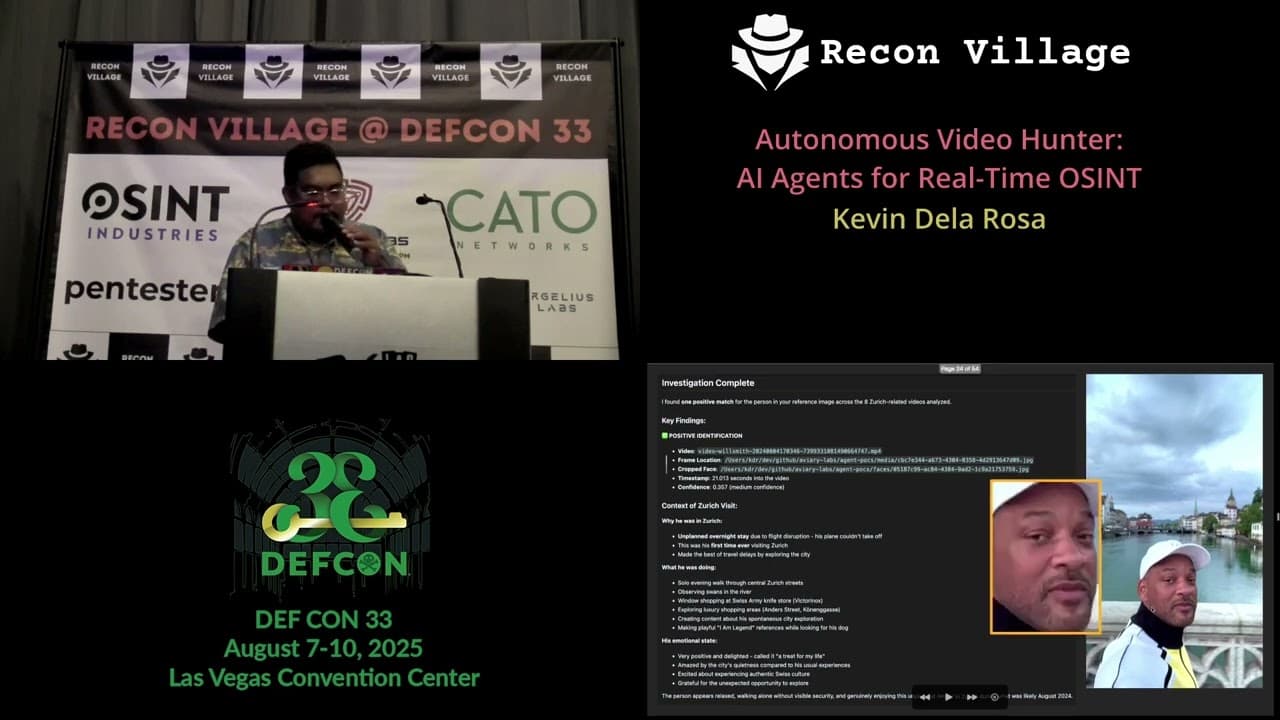
DEF CON 33 Recon Village - Autonomous Video Hunter AI Agents for Real Time OSINT - Kevin Dela Rosa