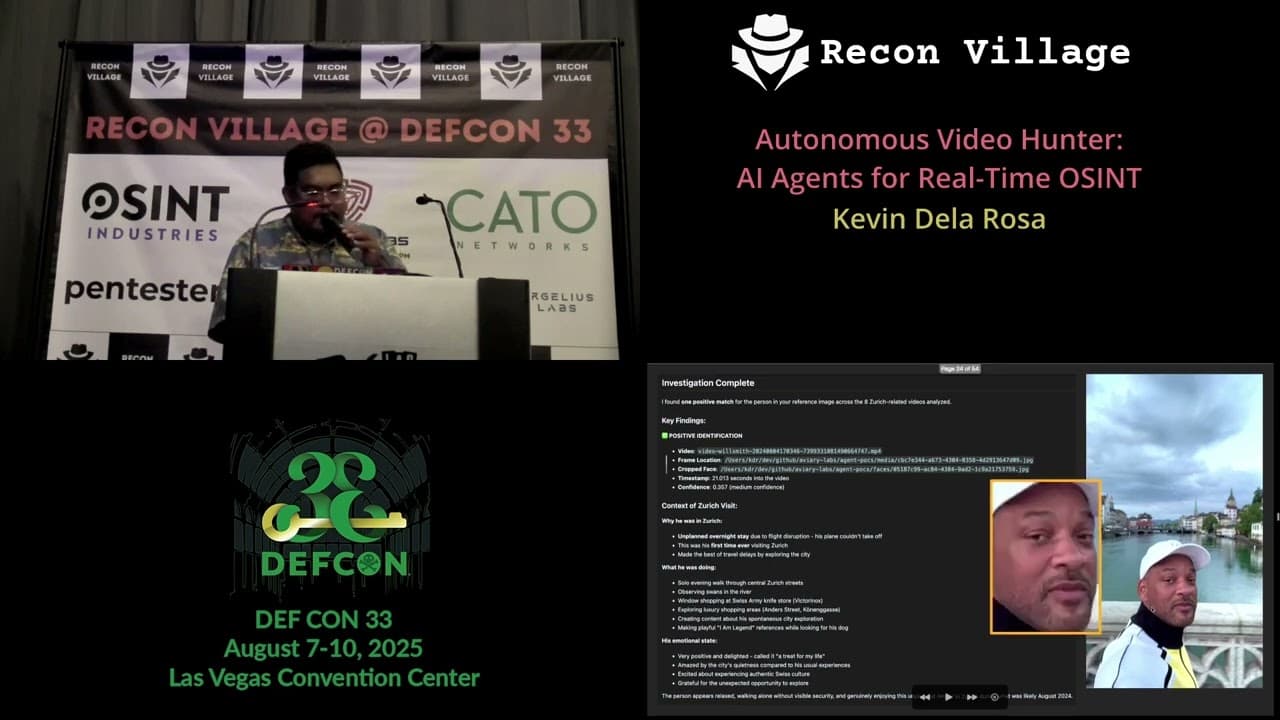
DEF CON 33 Recon Village - Discord OSINT - Zach Malinich
Description
This presentation explores the underutilized potential of Discord for Open Source Intelligence (OSINT) gathering, detailing how researchers and malicious actors scrape data. It covers specific search operators, the power of mutual server analysis, and the rise and fall of massive data scraping platforms like SpyPet and SearchCord.
Title: The Discord OSINT Goldmine: Tracking Identities and the Scraper Wars
Introduction
In the modern landscape of Open Source Intelligence (OSINT), platforms like X (formerly Twitter) and LinkedIn are the usual suspects for investigators. However, a massive, often overlooked repository of human intelligence exists within Discord. Originally designed for gamers, Discord has evolved into a hub for every niche community imaginable—including cybercrime and high-level security research. Zach Malinich's recent presentation at the DEF CON 33 Recon Village highlights a startling reality: while Discord feels like a private chat room, its public-facing features and the rise of industrial-scale data scrapers have turned it into a surveillance playground. Whether you are a red teamer, a bug bounty hunter, or a privacy-conscious user, understanding the mechanics of Discord OSINT is no longer optional.
Background & Context
Discord's architecture is unique. It isn't indexed by traditional search engines like Google in the same way a forum or a blog is. This creates a false sense of security. Users frequently share sensitive information—API keys, passwords, and PII—thinking their messages are ephemeral or restricted to a small group. In reality, the platform's 'Discovery' feature and the ease of creating 'Self-Bots' (automated accounts acting as users) make it highly susceptible to automated harvesting. As the security landscape shifts toward social engineering and identity-based attacks, Discord serves as the perfect bridge between an online handle and a physical person.
Technical Deep Dive
Understanding the Vulnerability: The Power of Search Operators Discord provides a robust set of internal search operators that act as 'Discord Dorks.' These can be used by anyone inside a server to filter massive amounts of chat history.
from:userallows you to isolate every message a target has ever sent in that server.has:linkorhas:filefilters for shared resources, which often contain credentials or sensitive documents.mentions:userreveals who the target interacts with most frequently.
A significant finding in Malinich's research is the 'Mutual Servers' technique. By viewing the servers a target shares with you, you can build a psychological and professional profile. If a target is in multiple niche exploit development servers, you can reasonably infer a high level of technical sophistication. Conversely, presence in 'Student Hubs'—which require an EDU email—can immediately link a handle to a specific university and often a real name through server nicknames.
The Rise of the Mega-Scrapers: SpyPet and SearchCord The most chilling aspect of Discord OSINT is the automation. Malinich explores 'SpyPet' and 'SearchCord,' platforms designed to scrape billions of messages across the platform.
- SpyPet: This service operated on a 'pay-to-spy' model. It tracked user bios, nicknames, and server history. Most importantly, it utilized a botnet to capture messages in real-time, meaning even if a user deleted a message, SpyPet had already logged it.
- SearchCord: This was an even more massive undertaking, indexing nearly 100,000 servers. It leveraged Discord's 'Preview' mode within the Discovery API. By mimicking the preview request, the scraper could see all messages in public channels without ever technically 'joining' the server, bypassing many traditional bot detection methods.
De-anonymization and Location Tracking Beyond simple chat logs, Malinich notes that advanced attackers can use de-anonymization techniques involving Cloudflare CDN caching. By observing how Discord serves media content, researchers have found ways to approximate a user's geographical location with surprising accuracy, even if the user is behind a VPN, by analyzing regional CDN edge nodes.
Mitigation & Defense
Defending against Discord OSINT requires a multi-layered approach at both the user and administrator levels.
For Users:
- Remove Linked Accounts: Disconnect your GitHub, Spotify, and Steam accounts. These provide the 'pivots' needed to find your real identity.
- Manage Privacy Settings: Disable 'Allow data from teammates to improve Discord' and restrict who can send you direct messages. This prevents attackers from seeing your mutual servers through a pending message request.
- Mindfulness: Assume every message sent in a 'public' channel (any channel visible without a specific role) is being recorded by a scraper.
For Administrators:
- Verification Levels: Set your server to 'Highest' (requires a verified phone number). This significantly raises the cost for scraper botnets.
- Disable Discovery: Unless your server absolutely needs to be public, keep it out of the Discord Discovery directory to avoid the 'Preview Mode' scraping vulnerability.
Conclusion & Key Takeaways
Discord is a powerful tool for community building, but its privacy model is often misunderstood. The 'Empathetic Banana' of the talk's title refers to the accidental discovery of sensitive data through simple keywords—a reminder that in the age of data scrapers, nothing is truly deleted. The key takeaway is that your digital footprint on Discord is likely larger than you realize. To stay safe, treat public Discord channels like a public square: don't say anything there you wouldn't want indexed by a search engine forever. For researchers, Discord remains a potent but ethically complex tool for reconnaissance that requires significant investment to master responsibly.
AI Summary
Zach Malinich presents a deep dive into Discord OSINT, arguing that the platform is a goldmine for intelligence if one understands its unique architecture and social dynamics. The talk begins by outlining standard OSINT goals: identifying personal information, occupations, and location data through Discord profiles. A key technical focus is the use of built-in search operators—similar to Google dorks—such as `from:`, `has:link`, `in:channel`, and `mentions:`. These allow for granular filtering through thousands of messages to find sensitive data like passwords, university graduation photos, or company badges inadvertently left in desk setup pictures. Malinich emphasizes 'Linked Accounts' and 'Server Nicknames' as primary pivots. By connecting a Discord ID to GitHub, Spotify, or Instagram, an investigator can often bridge an anonymous handle to a real-world identity. Furthermore, the talk introduces a sophisticated analysis of 'Mutual Servers.' By examining the types of communities a user joins, an analyst can infer their skill level and specialization. For instance, a user in servers for 'J Haddix,' 'Pen Tester Labs,' and 'Kaido' is likely a professional web application security researcher, whereas a user in 'Blue Team Labs' is likely a beginner in defensive security. The 'Student Hubs' feature is also highlighted as a significant privacy risk, as it often exposes real names and university affiliations via EDU email verification. The presentation then transitions to the history of large-scale Discord scraping. Malinich details 'SpyPet,' a service that tracked 14,000 servers and 600,000 users, notably capturing messages before they were deleted. While SpyPet was eventually shut down for TOS and GDPR violations, it was followed by 'SearchCord,' a much larger operation that indexed 95,000 servers and billions of messages. SearchCord exploited Discord's 'Discovery' feature, using a preview mode to scrape public channels without officially joining the servers. Finally, the speaker warns of a new, currently active, and unpublicized scraper based in Europe that focuses on gaming communities and uses DDoS Guard to evade takedowns. The talk concludes with practical defensive measures: removing linked accounts, setting server verification to the highest level (requiring phone numbers), disabling the 'Discovery' feature for servers, and being extremely mindful of the permanence of public channel messages.
More from this Playlist
DEF CON 33 Recon Village - Mapping the Shadow War From Estonia to Ukraine - Evgueni Erchov
DEF CON 33 Recon Village - How to Become One of Them: Deep Cover Ops - Sean Jones, Kaloyan Ivanov
DEF CON 33 Recon Village - Building Local Knowledge Graphs for OSINT - Donald Pellegrino
DEF CON 33 Recon Village - A Playbook for Integration Servers - Ryan Bonner, Guðmundur Karlsson