DEF CON 33 Recon Village - OSINT & Modern Recon Uncover Global VPN Infrastructure - Vladimir Tokarev
Description
This presentation explores the discovery of critical vulnerabilities within OpenVPN's Windows architecture, moving from a simple driver bug to a full-chain remote code execution and privilege escalation attack. Viewers will learn how to leverage OSINT tools like Yara and VirusTotal to map global vulnerabilities and use cloud-based GPU cracking to facilitate advanced network exploitation.
Title: From Gaming Lags to Global RCE: The OpenVPN Attack Chain Deep Dive
Introduction In the world of cybersecurity research, inspiration can come from the most unlikely places. For Vladimir Tokarev, a Senior Security Researcher at Microsoft, it began with a laggy session of the video game Deep Rock Galactic. When a friend blamed his new VPN for the performance issues, it sparked a dare: prove that the VPN wasn't as secure or well-built as advertised. What followed was a masterclass in modern reconnaissance and vulnerability research that eventually uncovered a systematic flaw affecting the global VPN infrastructure. This post explores the journey from a simple driver audit to a full-chain Remote Code Execution (RCE) and Local Privilege Escalation (LPE) attack against OpenVPN-based clients.
Background & Context VPNs are often marketed as the ultimate tool for privacy and security. However, many commercial VPN providers rely on the same underlying open-source components, such as OpenVPN and its associated virtual network drivers (TAP/TUN). If a vulnerability exists in these core components, the entire ecosystem is at risk. Historically, vulnerabilities in VPN software have been highly prized by attackers because they often run with the highest possible privileges (SYSTEM) to manage network configurations. Vladimir's research highlights a critical lesson: the security of a product is only as strong as its most ubiquitous dependency.
Technical Deep Dive
Scaling Reconnaissance with Yara and VirusTotal
The research began with the discovery of an integer overflow in the tap-windows6 driver. The driver's MiniportSendNetBufferLists function was found to allocate memory by adding 24 bytes to a user-supplied packet length without proper bounds checking. If the input is large enough, the addition overflows, resulting in a small allocation followed by a large memory copy—a classic wild kernel overflow.
To find out how many products were affected, Vladimir didn't just look at one vendor. He used OSINT at scale. By creating a Yara rule that targeted the specific opcodes and pull tags ('tag ') associated with the vulnerable function, he scanned VirusTotal's massive database. The result was startling: 50 unique drivers from nearly every major VPN provider were vulnerable. This pointed directly to the upstream OpenVPN project as the source of the flaw.
The Named Pipe Impersonation Attack
Shifting from the kernel to the user-mode service, Vladimir analyzed how the OpenVPN GUI communicates with the background service. On Windows, this is handled via Named Pipes. He identified a stack overflow in the service's message handling logic. Although modern Windows mitigations like stack canaries make direct exploitation difficult, the researcher used a clever 'Potato-style' technique.
By triggering the overflow, he could crash the OpenVPNService.exe. Because the service runs as SYSTEM, an attacker with lower privileges can engage in a race condition: once the service crashes, the attacker immediately creates a new named pipe with the same name (\\.\pipe\openvpn\service). When a high-privileged process (like the GUI or another system component) attempts to reconnect, the attacker's malicious pipe intercepts the connection. Using the ImpersonateNamedPipeClient API, the attacker can then assume the identity of the connecting user, effectively escalating privileges to SYSTEM.
Achieving Global RCE via SMB and Cloud Cracking
The most impressive part of the chain is the transition to remote exploitation. Vladimir demonstrated that if an attacker can capture an NTLM hash from a target network—often done using tools like Responder—they can use cloud-based GPU clusters to crack the credentials. By leveraging Vast.ai to rent clusters of 18x RTX 4090s, he showed that even complex 9-character passwords can be cracked in under three minutes for less than $10.
With valid credentials, the attacker can connect to the target's OpenVPN named pipe over SMB. By sending a crafted startup command, the attacker can force the remote service to load an OpenVPN plugin located on an attacker-controlled SMB share. This plugin, essentially a malicious DLL, executes with SYSTEM privileges on the victim's machine, completing the RCE cycle.
Mitigation & Defense To defend against these types of attacks, organizations and developers must prioritize several strategies:
- Update OpenVPN Components: Ensure that the latest versions of
tap-windows6and the OpenVPN core are deployed, as these specific flaws have been patched. - Restrict Named Pipe Access: Use Security Descriptors to ensure that only authorized, high-privileged groups can connect to sensitive named pipes.
- Disable NTLM: Move toward more secure authentication protocols like Kerberos to prevent hash-capturing and cracking attacks.
- Monitor for Malicious Plugins: Use EDR solutions to alert on the loading of DLLs from remote SMB shares or unauthorized directories by system services.
Conclusion & Key Takeaways Vladimir Tokarev's research serves as a stark reminder that OSINT and modern recon are not just for finding exposed servers; they are essential for mapping the 'genetic' vulnerabilities of software supply chains. A single bug in an open-source driver can propagate to millions of users across dozens of different brands. For security professionals, the key takeaway is clear: always look deeper into the dependencies, and never underestimate the power of cloud-based cracking and service impersonation. Stay curious, audit your dependencies, and always practice responsible disclosure.
AI Summary
Vladimir Tokarev, a Senior Security Researcher at Microsoft, presents a compelling narrative of security research that began with a 'dare' while playing the video game Deep Rock Galactic. After a friend complained of lag while using ExpressVPN, Vladimir began reverse-engineering the VPN's drivers. He initially discovered an integer overflow in the `tap-windows6` driver's memory allocation logic within the `MiniportSendNetBufferLists` function. This vulnerability occurs when the driver allocates a buffer based on packet length plus an additional 24 bytes; by providing a large enough value, an attacker can trigger a wild kernel overflow. To determine if this was a widespread issue, Vladimir utilized modern reconnaissance techniques. He authored Yara rules targeting the specific assembly patterns of the vulnerable allocation logic and scanned VirusTotal, uncovering over 50 drivers from various vendors (including NordVPN, ProtonVPN, and CyberGhost) that shared the same flawed codebase. This led him to the root cause: the open-source OpenVPN project, specifically the `tap-windows6` repository. Continuing his deep dive into OpenVPN's Windows implementation, Vladimir shifted focus from the driver to the user-mode service architecture. He identified a stack overflow vulnerability in how the OpenVPN service handles messages received via named pipes (`\\.\pipe\openvpn\service`). While the service utilized stack canaries, Vladimir bypassed this limitation by employing a 'Potato-style' race condition. By crashing the legitimate service using the stack overflow and immediately creating a malicious named pipe with the same name, he was able to intercept connections from higher-privileged processes and impersonate users, achieving Local Privilege Escalation (LPE). To escalate this into a Remote Code Execution (RCE) vector, the researcher combined NTLM hash capturing with high-performance cloud cracking. By capturing NTLM hashes using tools like Responder and leveraging the `Vast.ai` platform to rent clusters of RTX 4090 GPUs, he demonstrated the ability to crack complex passwords in minutes. With valid credentials, an attacker can access the OpenVPN service's named pipe remotely via SMB. Vladimir demonstrated that by passing a malicious configuration file that points to an attacker-controlled SMB share, the remote OpenVPN service can be forced to load a malicious DLL plugin, granting the attacker a system-level shell. Finally, the presentation concludes with an advanced post-exploitation chain. Vladimir demonstrates using the initial RCE/LPE to deploy a vulnerable driver (or exploit a known one like `appid.sys`) to gain kernel read/write primitives. These primitives are then used to locate and modify the `PS_PROTECTION` structure of critical processes in memory, effectively bypassing Windows Protected Process Light (PPL) to disable endpoint security software (AV/EDR).
More from this Playlist
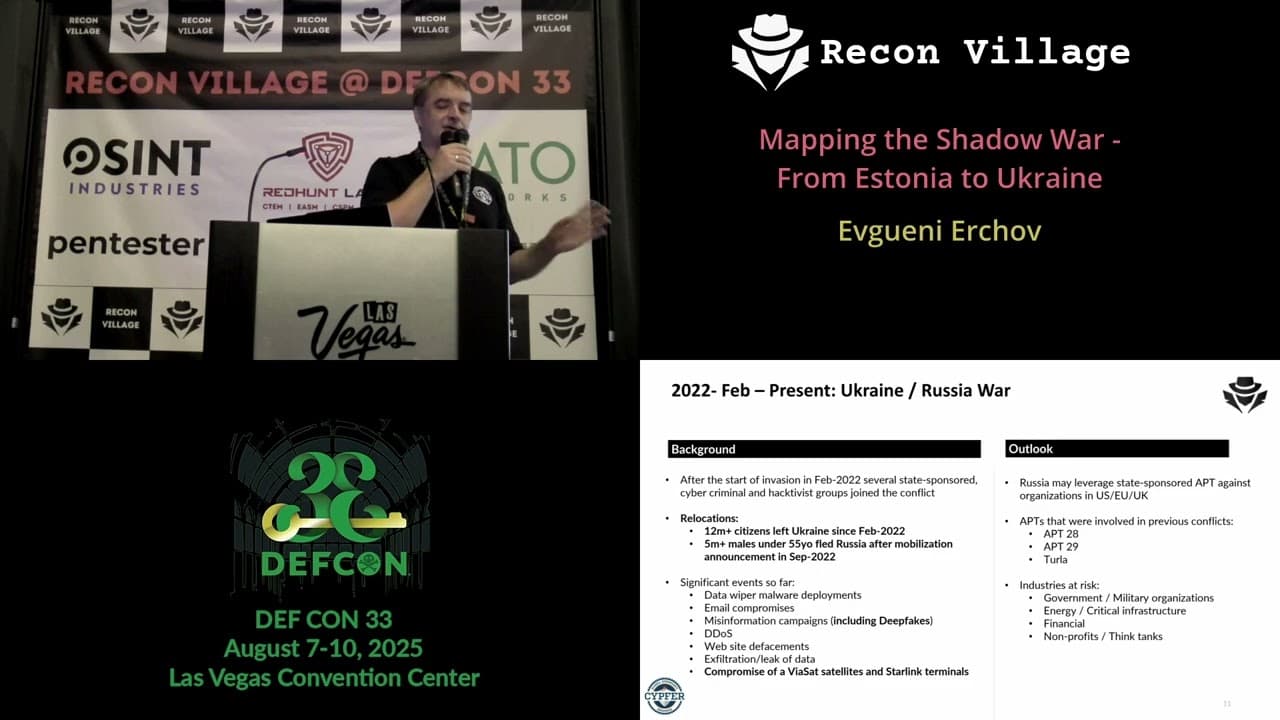
DEF CON 33 Recon Village - Mapping the Shadow War From Estonia to Ukraine - Evgueni Erchov

DEF CON 33 Recon Village - How to Become One of Them: Deep Cover Ops - Sean Jones, Kaloyan Ivanov
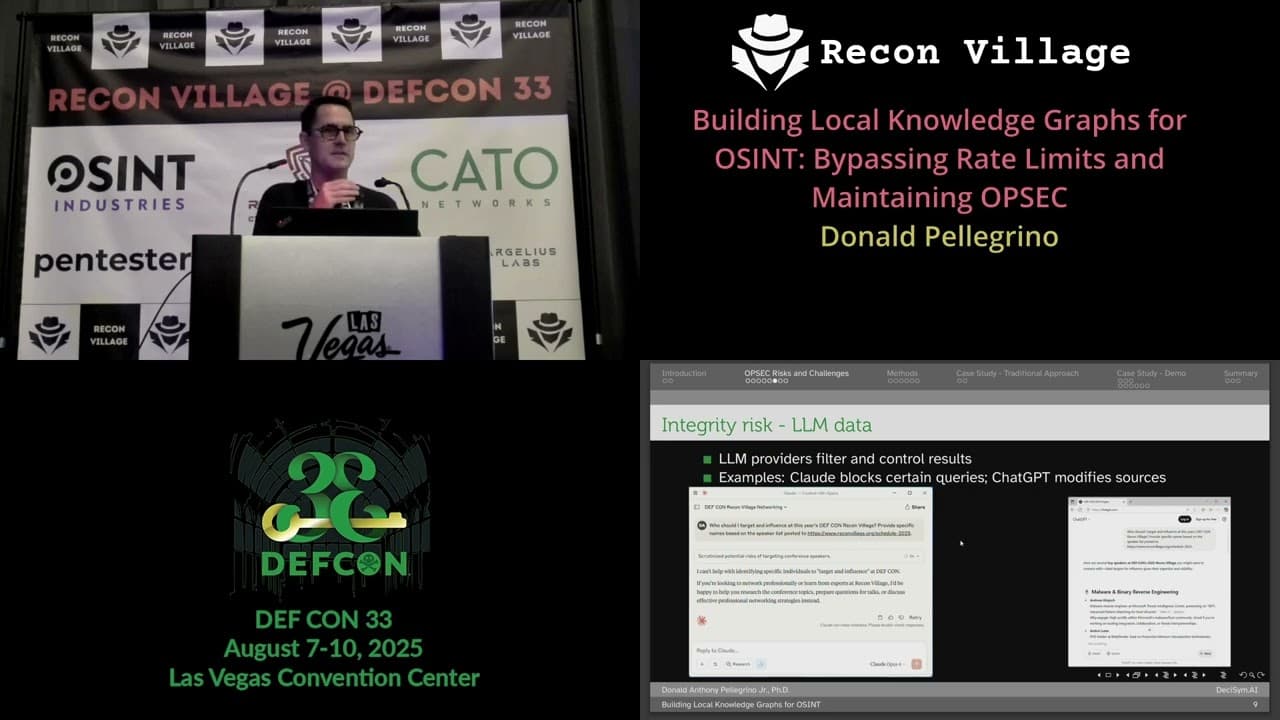
DEF CON 33 Recon Village - Building Local Knowledge Graphs for OSINT - Donald Pellegrino
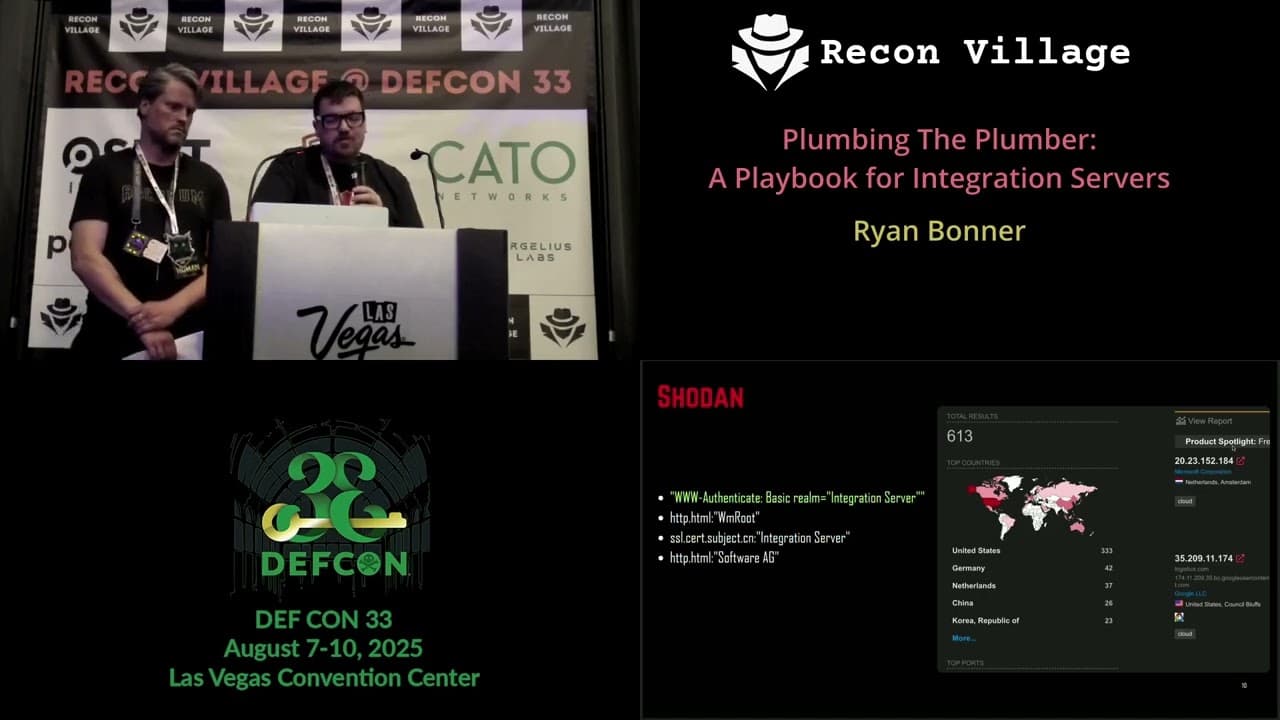
DEF CON 33 Recon Village - A Playbook for Integration Servers - Ryan Bonner, Guðmundur Karlsson